Don’t point at the moon.
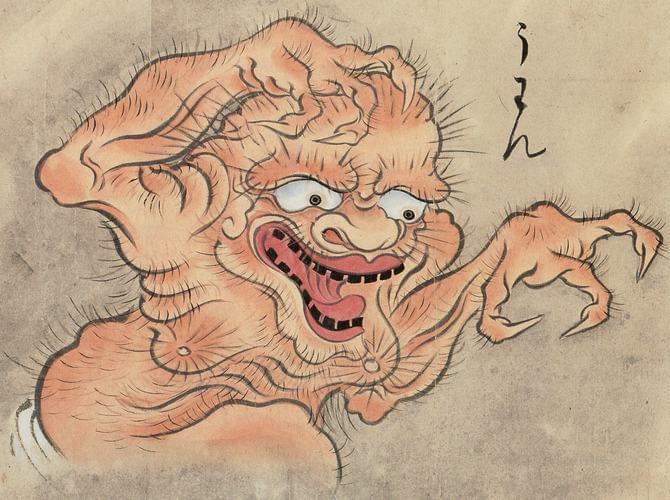
An old Japanese superstition says that by doing so, you insult the moon deity and you’ll wake up with sore ears or even missing ears.
On today’s show, I’m going to talk about all kinds of moon myths, lore, and superstitions.
There’s a rabbit on the moon. You’ve probably seen it.
But what most people don’t know is that its image was placed there by the gods long, long ago for all creatures to remember the bunny’s act of courage and sacrifice.
I’ll tell you this ancient Buddhist tale along with other beautiful, dreadful, and interesting Japanese moon lore.
On today’s show, let’s learn about all things moon.
Japan knows about Tsukimi moon viewing when you go out and admire the full harvest moon.
But did you know Japan has a second moon viewing distinctly its own when you admire the beauty in an imperfect moon? And you’d better do both or it’s bad luck.
On tonight’s show, I’m going to talk about all things moon, myths, tales, superstitions, and beautiful moon language.
Introduction
Hey, hey, my name’s Thersa Matsuura and you’re listening to Uncanny Japan, the place where I talk about all the more obscure parts of Japanese culture.
I’m also the author of the book of Japanese folklore and coming out at the end of this month the Yōkai Oracle Deck.
A wonderful Christmas gift for that hard to buy but likes cool things friend or relative. Just putting that out there.
I want to thank our network, Spectrevision Radio, who are awesome in all things.
But I want to remind you too that if you’d like to listen to ad free versions of this show for just $5 a month, you can become a real live kitsune over on the Uncanny Japan Patreon page.
You’ll get the episodes without ads and usually a little bit early too.
There are also recipes, bedtime stories, weekly posts and updates, as well as natural soundscapes for relaxing, studying or meditating like ocean waves, rice fields full of frogs, or walks in the forest.
And becoming a patron also really helps support the show.
Or if you’d like to support the show for free, you can leave a review of the book of Japanese folklore. That’s super helpful too.
While I’d love for you to buy the book at a local bookstore, Bezos really has us authors by the balls. Reviews really do help.
And comments, comments on YouTube and Spotify are also awesome. Thank you.
I don’t know about you, but I’m kind of smitten with the moon. Always have been. But even more so the older I get.
Today let’s talk about all kinds of moon related myths and lore, superstitions and beautiful words and phrases.
The Birth of the Moon God
So let’s start way back with Japanese beginnings and where did the moon come from anyway?
Remember in episode 132 when I told you about Japan’s origin story? An extremely truncated version goes something like this.
The divine siblings, Izanagi and Izanami, used a holy spear to stir the world into existence and then came down, got married and started creating various other gods and goddesses and islands and volcanoes and such.
Izanami tragically died after giving birth to Kagutsuchi, the god of fire, and descended into the underworld, also known as Yomi.
Her brother, husband, was so distraught he followed her. All kinds of stuff happened there and there are different versions.
But just know that Izanagi had to flee for his life, narrowly escaping being mauled by the hags of hell, the shikome.
Phew.
So Izanagi is covered in both literal and metaphorical filth, the spiritual pollution of the Yomi underworld.
He drags himself to a nearby river and begins a ritual purification bath.
As he washes, the sun goddess Amaterasu springs from his right eye. In Tsukuyomi, the moon god emerges from his left.
And then of course, there’s the wild Susanoo, storm god, born from his nose, which I talk about in episode 173. She’s wild. Check that out.
But today, let’s get mellow and talk about the moon.
Tsukuyomi no Mikoto
That original moon god was more formally known as Tsukuyomi no Mikoto.
There are actually two different stories about his birth. One says he sprang from Izanagi’s right eye. Another claims that he came from a white copper or bronze mirror that Izanagi was holding in his hand.
Either way, meet Tsukuyomi no Mikoto.
There isn’t a lot written about him in Japan’s two main ancient texts, the Kojiki and the Nihon Shoki, especially compared to his sister Amaterasu or his tempestuous brother, Susanoo.
There are some folklorists who insist that Susanoo and Tsukuyomi started out as the same god, then separated over time. That’s an interesting argument with some solid evidence.
The Murder of Ukemochi
But what I want to talk about is one fascinating story about how Amaterasu learned about Ukemochi, the goddess or god, depending on the version, of a food, and sent her more chill brother to go and say hi.
The moon god shows up, and Ukemochi, wanting to impress him, declares that she will prepare a grand feast.
She turns toward the land, opens her mouth, and spews a whole bunch of boiled rice.
You can almost imagine Tsukuyomi’s expression, wide-eyed, frozen, horrified, but that doesn’t deter the food goddess. No.
Next, she turns to face the ocean and promptly vomits a load of fish and seaweed.
At this point, the moon god is surely pale and in some state of shock, but no one ever accused Ukemochi of being good at reading the room, because she keeps going.
Next, she whirls around to face the forest, opens her maw again, and out-gallops all manner of wild game.
Only then does she calmly begin preparing the feast.
It takes a moment for the moon god to shake off his utter dismay at what he just witnessed, but eventually he looks down at the food, decides that it’s impure because of the disgusting way the hostess created it, and doing what any mythological deity with more power than patience might do, he kills her.
Now, when news of this reaches his big sister, the sun goddess, she is livid, absolutely furious.
She calls it unforgivable behavior and swears never to look at her brother again.
And because of that celestial sibling breakup, the two have stayed apart ever since.
That, the old stories say, is why the sun and moon travel the sky on opposite schedules, rarely seen together even today.
So that wasn’t exactly a peaceful story.
The Rabbit on the Moon
Okay, let’s turn our gaze from the divine murderer to something softer, more charming, like those markings on the moon.
Growing up, I remember hearing about the man and the moon, though honestly I could never quite see him.
But across East Asia and even parts of indigenous North and Central America, people don’t see a man at all. They see a rabbit.
In Japan, China, and Korea, that rabbit is standing in front of a mortar and pestle, doing something, although that’s a little hard for me to see too.
So where does this idea come from? Let me tell you a lovely story.
Buddhist Jātaka Tale #316
You see, there’s a series of Buddhist Jātaka tales, ancient stories about the Buddha’s previous lives.
In them, he appears as all sorts of beings, animals, and humans. And he demonstrates virtues like generosity, wisdom, patience, and self-sacrifice.
There are hundreds of these tales, and in number 316, the Buddha appears as a bunny.
The story goes like this.
On the night of a full moon, several animal friends, a monkey, an otter, a jackal, and a rabbit, decide that today they will practice the highest form of giving.
As it happens, a traveling mendicant appears, who is actually Sakra, the king of heaven and disguise.
The animals decide it is to him that they will offer something and perhaps get some kind of reward in return.
The monkey scampers up a tree and brings back a bunch of ripe mangoes.
The otter waddles away and returns with fish that it stole from a fisherman’s net.
The jackal one-ups everyone by discovering a corpse, tearing off a chunk from the body and proudly offering that.
Lastly, comes the little bunny, who does nothing really but eat grass all day long and has nothing cool like mangoes, pilfered fish, or human flesh to give to the poor man.
So when it’s the rabbit’s turn, it bows its head and says, “I’m sorry, I have nothing to give, except myself. Build a fire and I shall jump into it.”
The beggar is stunned, moved beyond words by this pure act of compassion.
At that moment, he reveals his true identity and tells the animals that it was the rabbit’s gift, simple, honest, and selfless, that was the greatest of all.
Then he announces that this little act of courage will be remembered forever.
He lifts the rabbit’s image onto the moon so that every creature everywhere, through all time, can look up at night and remember the self-sacrifice and purity of its heart and strive to be more like the bunny.
Hmm, I don’t think that worked out too well.
I would venture to guess that these days, not a lot of people remember any of that story when they’re looking at the moon. So I guess it’s up to us to spread the word.
We definitely need more of that pure bunny heart in the world today.
If you ever see the moon and you happen to be standing by a nice and safe-looking person, ask them if they’d like to hear a story.
The Rabbit’s Transformation Across Cultures
So that’s the likely origin of the rabbit on the moon.
As the tale traveled through China and eventually reached Japan, it changed a bit.
In China, the rabbit gains that iconic mortar and pestle silhouette and is said to be pounding the herb of immortality for the moon goddess.
By the time the story arrives in Japan, though, that immortality elixir turns into something much more familiar and I’d venture. Delicious mochi cakes.
Rabbit Luck and Symbolism
Okay, let’s talk just a little bit about rabbit luck.
In Japan, you can sometimes find charms or omamori decorated with bunnies, and they have quite a few different meanings.
Of course, you have the usual blessings of good fortune, financial luck, protection from evil.
But one detail I really love that I didn’t know about is the character for rabbit looks almost exactly like the character manugareru, which means to escape.
And because of this resemblance, rabbit charms are believed to help you avoid danger or slip away from misfortune.
Rabbits are also connected to fertility, obviously, and to prayers for children and safe child birth.
And since rabbits hop lightly and smoothly, that movement becomes a metaphor for things going well or progressing without obstacles.
In the Chinese and Japanese zodiac, each animal has attached to it several key words. The rabbits include gentleness, safety in the home, leaps forward or progress, and of course good luck.
Alright, let’s hop back to the moon.
Tsukimi: Moon Viewing Traditions
I think the tradition most people are familiar with is tsukimi, moon viewing.
Moon viewing was imported from China during the Heian era, with the first officially recorded moon viewing banquet held at the Imperial Court in 909 CE.
After this, high-ranking nobles in layered silks sitting beneath the full moon, in an elegant palace garden, or gliding in lacquered boats across a pond, just to admire the reflection of the moon in the water.
Sake cups are floating downstream so drinkers could infuse them with moonlight.
Art musicians played gentle koto and flute music, while aristocrats took turns reciting waka poetry.
And what were these poems about? Why, loneliness, longing, unrequited love, the fleetingness of beauty, enlightenment, and memories of the dead, of course.
This was the golden age of moon viewing, and it was all very genji monogatari.
Over time the custom spread beyond the court, and farmers adopted it as well, transforming it into not only an evening of moon appreciation, but also a harvest Thanksgiving festival.
Offerings were made, freshly gathered chestnuts, persimmons, rice, sake, and susuki, pompous grass, which was believed to ward off evil.
Japan’s Two Moon Viewing Nights
Now here’s something I find very fascinating. Japan actually has two moon viewing nights.
But first I need to tell you about the names for the moon.
The new moon and the full moon are the same as in English. New moon is shingetsu, and full moon mangetsu. The same.
But you know in English we call the half lit moon a first quarter moon and the third quarter moon. Not so in Japanese.
It’s called yumiharitsuki. Yumi means bow, as in a bow and arrow, and yumihari means to draw your bow.
Imagine a celestial samurai with his bow, which would look like a crescent, and then he’s pulling it back to make a half moon. I just love that image.
Crescent moons are named after how many days it’s been since the new moon. So a two day moon, futatsuki, is a very thin sliver of a crescent moon, two days after the shingetsu, the new moon.
This naming continues as the illumination increases. And then you get to jūgoya, the fifteenth night. That’s the full moon. In the fall, the harvest moon.
Another name for the harvest moon is jūgoya, the fifteenth night. And this is usually the tsukimi most people think about, the one that came from China.
But there’s also a second moon viewing night, the jūsanya, the thirteenth night, which is one lunar month later.
This one is distinctly Japanese, and importantly, the moon is not full. It’s appreciated precisely because it’s imperfect.
It’s a moon a couple days before fullness.
Traditionally, you are supposed to celebrate both nights. Skipping one was considered bad luck.
It’s even called katatsukimi wa engiwarui. One-sided moon viewing brings misfortune.
Some books even say that originally this referred to courtesans. If you spent the fifteenth night with your favorite lady, you’d better spend the thirteenth night with her too. Or else, bad luck.
Wonder what that was referring to.
Modern Tsukimi Customs
Tsukimi dango, mooncakes, are eaten on both nights.
You’ll see them for sale everywhere, round, white mochi balls on trays or stacked into little pyramids. They represent the full moon.
Recently, there are all kinds of creative versions, rabbit-faced dango filled with red or white bean paste, and even traditional Chinese mooncakes, called geppei, with intricate patterns pressed into them.
These days, tsukimi has gone modern and commercial.
Every fall, McDonald’s releases its once-a-year tsukimi burger. Basically, a burger with a fried egg on top. Because moon.
And tsukimi soba, or udon, are easy. Just crack a raw egg into your noodles, and voila, instant moon viewing.
There are also old names for these two moon viewing days that go all the way back to the Jōmon era, and they’re based on seasonal foods.
The imo meigetsu, or potato moon, was the fifteenth night.
Mame meigetsu, the bean moon, and kuri meigetsu, the chestnut moon, referred to the thirteenth night.
And they were of course named after the staple foods harvested during those times.
Tsukimi Today
Tsukimi today isn’t quite as big a deal as it used to be. I’m sure it depends on the family and how busy they are.
Life has gotten very fast-paced, and children come home from school only long enough to be taken to their next lessons. Be it swimming, calligraphy, English, piano, Gram school, and older kids, junior high and high schoolers, they sometimes don’t get home until ten o’clock or later.
It seems like no one’s looking at anything outside.
Yesterday while I was standing on my veranda, watching the most magnificent sunset, I watched a guy walk quickly down a narrow path between two rice fields and just pass right by without even a glance.
I debated yelling down at him to check it out, but then he was probably in a hurry to get somewhere, and thanks to the bad tourists, foreigners probably shouldn’t be screaming across the field, “Look behind you! Look at the sun!”
So I just let him go.
Tsukimi Dorobō: Moon-Viewing Thieves
Let me tell you about one Tsukimi tradition that I just learned about that I’ve never seen although it’s supposed to be practiced in my prefecture.
It’s a very old custom, and it’s called Tsukimi Dorobō, moon-viewing thieves.
And basically, it’s Japan’s version of Halloween.
On the day of the moon-viewing, some families or sweet shops or even other stores, if there happens to be a whole street of shops participating, put out a whole bunch of offerings to the moon.
Imagine tables stacked with mooncakes or just a big basket filled with candies, chocolates, cans of juice, all kinds of stuff.
And beside the table is a sign that says, “Please take one or two or some.”
Children walk around with their parents after school with a bag, and they get to “steal” some of the sweets.
I went down a rabbit hole, and I watched a bunch of YouTube videos.
It’s such a charming communal little ritual, and honestly, the treats look really darn good too. No crap candy. I’m looking at you, candy corn, circus peanuts. Ugh.
And remember, once Tsukimi offerings have been made, it’s perfectly fine to eat the sweets yourself too, because doing so lets you take in a little bit of that moon energy, and with it, a little health and happiness too.
Moon Beliefs and Superstitions
So let’s talk about some moon beliefs. Comforting ones. Strange ones. And downright spooky ones.
I’m not sure how prevalent or believed these are nowadays. Younger folk are seeming to not be very interested in this stuff. They have better things to do on their phones.
Sad side note, this area I live in has had summer festivals for as long as there have been people living here. But after the pandemic, the younger families decided it was too much work to organize, practice dancing with the kids, set everything up. Anyway, they’ve stopped.
There’s not going to be any more. No more summer Obon festivals in this area.
The older generation who are keeping it up are just getting too old to do all the work themselves and the young parents just don’t feel it’s worth it.
And rant. Let’s talk about superstitions.
Don’t Point at the Moon
Let’s start with one that was new to me. Spirits point at the moon.
If you do, you’ll offend the moon deity and be punished with bad luck, ear pain, or, in some versions, your ears will be cut during the night.
Moonlight and Newborns
Another superstition warns that letting moonlight shine into a newborn’s room will attract fox spirits.
It might sneak in, spirit the baby away, and leave something else in its place.
Sleeping in Moonlight
You also don’t want moonlight shining directly on your face while you’re asleep.
Moonlight is considered spiritually thin and it can weaken your energy, make you sick, or invite unwanted visitors.
More Obscure Moon Beliefs
Okay, let’s go even more obscure.
An Aomori folk song says that the moon makes the rabbits dance.
Also, there are several Edo period books that claim ghosts are most visible on the 13th night moon. That imperfect, slightly shy, Jūsanya.
And lastly, you’ll see a lot of pompous grass, susuki, decorations around the moon-viewing festivals. It’s believed to be protective.
Just a couple of weeks ago, I saw a car full of older ladies pull over by the river and gather big armfuls of it. I’d like to believe they were taking it home to decorate and keep the bad spirits out.
Traditionally, the sharp edges of susuki leaves were thought to cut through evil and bad luck.
Beautiful Japanese Moon Language
Let’s end with some beautiful imagery and words.
Do you know how they say Inuits have 50 words for snow? Well, Japan has tons of poetic names for the moon. Here are some of my favorites.
Poetic Moon Names
A dawn moon is called an Ariake no Tsuki, meaning the moon is still visible at sunrise. I saw that today, by the way.
A lingering or fading moon is called a Zansuki.
A cold winter moon is a Kansuki.
Have you ever had moonlight cut into your room? That’s called Tsuki Kagesasu.
Izaioi, hesitant moon, a moon that is rising a little late.
The Waiting Moons
Then, the name of these moons are just delightful. They are poetic names for the waxing gibbous or the waning moon phases, and they describe how long you have to wait to see the moon rise.
Back in the day, the people were much more in tune with the movements of the moon.
The first one is Tachimachi Tsuki, meaning the moon you can stand and wait for. This moon appears just after sunset, so you don’t have to wait long.
The Imachi Tsuki means a moon that you sit and wait for. It’s not right after sunset, so you’d better take a seat.
The Nemachi Tsuki is the moon that you lie down and wait for. You guessed it, you’re already in bed when it rises.
And finally, the Fukemachi Tsuki, the moon you wait for deep into the night. This one rises after midnight. This is the moon for insomniacs, poets, and lonely wanderers.
Buddhist Moon Wisdom
Buddhism also loves using the moon and its teachings, and here’s one of my favorites.
Tsuki wa jōman, the moon is always full.
Even when clouds hide it, even when it’s waxing and waning, even when we can’t see a single sliver of light, the moon hasn’t changed at all.
It’s still perfectly round, perfectly bright.
Buddhist teachers used this as a reminder that our true nature, our clarity, and our goodness is always there. Sometimes life just obscures it for a little while.
Tsuki wa jōman.
Thank you all for listening, stay safe and well, and I’ll talk to you again in two weeks.