
Hello, Uncanny Japan is author Thersa Matsuura, that’s me, exploring all that is weird from old Japan. Strange superstitions and old wives’ tales, cultural oddities and interesting language quirks. These are little treasures that I dig up when I do research for my writing. And I want to share them with you here on Uncanny Japan. I hope you like the show.
Introduction: Beach Recording and Japanese Superstitions
Hey, hey, this is Thersa Matsuura, and you’re listening to Uncanny Japan. This month, I made it to the beach. Yay. To give you an image of the beach, this isn’t the kind of beach I grew up at, or maybe anyone—if you have an image of a beach, you think of sand, white sand, gold sand, yellow sand. No, this is—Yaizu is a very austere beach.
We have these guys, rocks, only rocks, and driftwood, and sticks, and not even any shells. So it’s a very—like I said, it’s austere. It’s kind of cool in that. It is that way. And you’re not allowed to swim here, so people don’t swim. They come to fish. They come to throw rocks, I suppose. I’ve seen that.
And yeah, so I guess what happens is it’s very shallow for a tiny bit, and then the ocean just drops straight away. There’s this huge shelf. And it’s very shallow, and it’s very shallow, and there’s this huge shelf. And it’s dangerous, so people aren’t allowed to even go into the water. I mean, I haven’t even seen people wade. And I don’t know. It’s kind of—I’m not used to that. When I see an ocean and waves, I kind of want to go in there. But I have yet to, and I have yet to see anybody. So anyway, I’m at the beach. There’s no wind. It’s gray. It’s warm. It’s pretty good conditions. There’s a boat coming. It’s really big. I don’t know how it’s this close to the shore, but I guess it’s that drop away, huh? So he might be tugging by. You might hear him or her, as the case may be. I think boats in Japan are all she’s, right?
OK, so today, what I’m going to talk about is three superstitions. These are quite common, I think, when you first come to Japan. Or if you know anything about Japan, you probably have heard of these or you come across these very quickly. But again, I did a little digging to find out if there was anything else on them. And I found some stuff, which was kind of interesting. So I wanted to share that with you guys. So superstitions.
Superstition #1: Don’t Cut Your Fingernails at Night
So number one is yoru ni tsume wo kitte wa ikenai. That’s horrible Japanese. Yoru ni tsume wo kitte wa ikenai. So basically, don’t cut your fingernails at night. And if you do, you will not see your parents on their deathbed. Something—there’s different variations of it. But you’re not supposed to be cutting your nails at night. It’s very unlucky.
I always assumed that this was just a kind of a reprimand to children not to cut their nails at night. Because then you got, like, nails scattered on a tatami mat floor. And someone could step on them. And it’s just annoying, right? Clicking your nails at night. And that’s part of it. I have read in Japanese some sites say, yeah, it’s just etiquette. You don’t do that. And yeah, just for children.
The Burning Corpse Smell
But there were some other things that came up that I have, again, never seen on an English language site. And one of them is—so at night or night or in the day when you cut your nails in Japan, instead of throwing them in a little wastebasket—this was a long time ago—they had a fire in the middle of the room where they cooked. They kept warm and everything. And they just collect the nails. And they just throw them on the fire.
As you can expect, they smell really bad, burning fingernails. And there’s this idea that they smell like burning corpses, you, which is also evidently bad luck. Or at the very least, you don’t want your house smelling like a burning corpse in the middle of the night. So that was one thing I read.
Evil Spirits and Sharp Blades
Another was that by cutting your fingernails—I’m not sure the connection here—you would agitate ghosts and bad spirits. So there was something about the cutting that would lure these bad, evil apparitions into your home. Again, you don’t want to be cutting your nails at night because that might happen.
Another one would be pointing a blade, any kind of blade, toward yourself at night would, again, invite a bad spirit. They’re called “akuryō” in Japanese. “Aku” would be bad or evil. And “ryō” would be spirit. So that, right? Again, you don’t want that to happen.
The Dangerous Old Nail Clippers
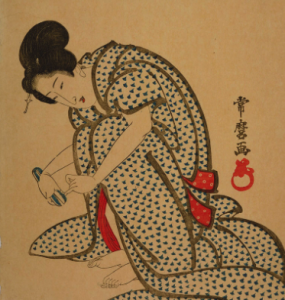
And then I was looking at old hanga—engravings and paintings. And I was thinking about cutting your nails. Like, nowadays, we have fingernail clippers. And again, you have an image of what a fingernail clipper is. But back in old Japan, their fingernail clippers were—I can’t describe them. I’m going to put a picture or some pictures up on the website for you to see.
Because they are, they’re these sharp blades, like I would say like tiny scissors. But they’re kind of creepy looking and scary. And the biggest—the reason I found—most overwhelming reason not to cut your nails at night was because these—they’re not like little subtle fingernail clippers. They’re like blades. And they’re these big scissors. And it’s like, ka-chunk, ka-chunk, ka-chunk, when you’re cutting. And it would be very easy to cut your finger, which you really don’t want to do at night. So, whatever the reason, in Japan, you’re not supposed to cut your fingernails at night. OK. So that was one.
Superstition #2: Don’t Whistle at Night
The second superstition is yoru kuchibue wo fuite wa ikenai. Yoru would be nighttime. Kuchibue is to whistle. And fuite wa ikenai means you can’t do it. You can’t whistle at night. This is fun because, again, it’s something you can’t do at night.
And again, I’m thinking it’s for kids because you’re annoying the neighbors. Japan, houses are quite next to each other. And the walls are quite thin. So yeah, that would be annoying to have people whistling at night. There’s a reason for it. But before I get to the reason for it, let me tell you why they say you can’t do it. So if you do it, you just can’t say not do it. You have to have a reason. There’s got to be something bad that’s going to happen.
What Happens If You Whistle at Night
The one I hear and heard when I first got to Japan, and I hear the most around where I live, is it invites snakes. That snakes will come if you whistle. And I’ve asked some friends, and that’s the one they’ve heard the most. But I’ve also read that if you whistle at night, you invite ghosts. Again, spirits, bad spirits, demons. You invite robbers.
Here’s two interesting ones. The wind will blow. The ocean will grow turbulent. So you see how I did this kind of weird segue down at the ocean, and I use the ocean here. Not really a segue, but yeah, OK. So the wind will blow. The ocean will grow turbulent. Your parents will die soon. Yeah, that’s horrible.
And then there’s the one—my favorite is, if you whistle at night, worms will come and lick your mouth. Isn’t that awesome? Don’t do it. You’re not allowed to whistle at night.
The Dark History Behind the Superstition
Now, the reason not to whistle at night, besides being annoying and etiquette and good manners, and you just don’t want to be whistling in the middle of the night, is—and I’m upset because I found this a lot on Japanese sites, but I really couldn’t find anything that looked straight up a slurred believable. I mean, people wrote about it, but I couldn’t find the original source or any old documents that could be quoted.
At night, traders would—traders, as in bad traders, like thieves and stuff who are trading goods and stuff, services—would use whistling as a sign. So they could let each other know where they were and what they wanted and stuff without actually bumping into each other. Because it’s dark, right? So you just go around, you whistle, and then someone whistles, and you’re like, oh, there’s another guy I need to trade with or do something with.
But this is what I wanted to find some real information on, was—but I found it so many places—human trafficking. They used to sell, sell, give away children, is how it went. And the whistling was a way of—yeah, if you got a child to sell, there you go. And you whistle, and someone whistles back, and then they come and they take away the child and give you some money or something.
And one of the—like I said, I was talking about how don’t whistle because ghosts will come or snakes will come or worms will lick your lips. But one of them, too, is that if you whistle at night, someone will come and take—a child, these types of child—someone will come in and take you away, which might quite have literally been the truth. If that’s a true saying or not, I don’t know. I don’t know. But I’m still looking for that. If I can find something that’s straight up legitimate, I will put that on the site. But for now, that’s the superstition.
Superstition #3: Morning Spiders vs Night Spiders
Three is about spiders. We had snakes. We had fingernail clippers. Now we have spiders. Asa gumo wa kami no tsukawa, yoru gumo wa dorobō no tsukawa. That’s one. There’s many versions of this, variations. Asa gumo wa fukujin, yoru gumo wa enma. The first one is basically morning spiders bring good luck, nighttime spiders bring thieves or robbers.
The second one, morning spiders are messengers of God, and nighttime spiders are messengers of Hell. Again, why? Why is it the same spider, right? Why is a morning spider good and a nighttime spider not good?
Why Morning Spiders Are Lucky
I kind of looked around. Basically, morning spiders have a good image because they only spin webs on fine days. So if you wake up and you see a spider spinning a web, you know it’s going to be a wonderful day. They also kill bad insects. Really, spiders aren’t so bad.
But at night, you can walk into webs. That’s pretty creepy. They kind of look icky, too, I guess. Just nighttime spiders have a bad image. There wasn’t a whole lot on why morning, why night. But basically, it’s that. I mean, you can kind of get the idea.
The Kyūshū Exception
Pretty much everyone I’ve talked to up and down Japan, they believe or they’ve heard this version of the spider thing. There’s another one, though. It’s in Kyūshū. And they call a spider—this is fun because it’s kind of a play on words. They call a spider a kobu. And yoru, so night, so nighttime spiders, yoru kobu, is—again, yoru kobu is nighttime spider.
But a play on that word means happiness or to be glad or to be pleased. So there, it’s the opposite—not the opposite so much. But basically, you don’t want to kill a nighttime spider because he’s there to bring happiness. In the end, I guess you don’t want to kill any spiders because they’re kind of cool. Then again, Japan has these monster spiders. So yeah, there’s the spider one.
Conclusion: Using Japanese Superstitions in Stories
I’ve used that in a story, “The Spider Sweeper,” which was—what? It was in Black Static, the horror magazine from the UK. And it was also in my recent book, “The Carp-Faced Boy and Other Tales.” So yeah, I kind of like the spider lore. There’s a lot going on there. And I used as much as I could kind of—I want to say seamlessly. I kind of slipped it into the story. So yeah, Japan and spiders have kind of a neat relationship.
So there are your three superstitions today. One is don’t cut your fingernails at night because you won’t see your parents when they pass away or ghosts will come or something bad. Another is don’t whistle at night because snakes, ghosts, robbers, the wind will blow. Your parents will die soon. Or worms will come and lick your mouth.
And the last one is spiders at night. One part of Japan says you’re supposed to kill them because they invite bad luck. And part of Japan says, no, no, don’t kill them. They bring good luck. So probably a good idea just to let them be. There you go. These are—there’s so many superstitions. And to me, they’re all very fascinating. And it’s kind of fun looking into these.
I will be back next month and talk about something else. I’m thinking about talking about a yōkai next time. We’ll see. See what comes up. Hope everyone has a wonderful day, a wonderful night, a wonderful afternoon. And I will talk to you soon. Thanks for listening.
Thank you again for listening. I’m Thersa Matsuura. You can find me on Twitter, Facebook, Patreon, et cetera, by searching for my strangely spelled name, T-H-E-R-S-A, M-A-T-S-U-U-R-A, or Uncanny Japan. Talk to you soon.
Credits
The intro/outro music of Uncanny Japan is a song by Christiaan Virant (“Yi Gui” from Ting Shuo). The whole album is just gorgeous as it everything else by FM3.








While I was living in Japan (’93-’99, in Shikoku), a coworker died of a heart attack. I was honored to be allowed to pay my respects to his family and to his resting body. At that time, I was told that the family members would be cutting their nails to burn with the body to act as money after death.
And now, of course, I can find nothing to back that tale up, so perhaps not.
Erik, thank you for commenting. I will absolutely look this up and ask around. I haven’t heard of it personally, but it very well could be something done only in Shikoku. In my area, little personal “presents” or items that you would like the deceased to take with them to the afterlife are often placed with the body before cremation. My husband (a huge rock fan) gave his grandfather a cassette tape with “Stairway to Heaven” on it. I thought that was quite sweet. I’ll most definitely look into the fingernail thing! Thanks again.
I just stumbled over your podcast today and I just love listening to all these little folktales and myths. But when I listened to episode 6, I recognized myself when it comes to whistling in the night.
I live in Sweden and I’m born here. But my parents come from Vietnam, so I was brought up with Vietnamese/Chinese customs and was taught early on that I was absolutely not allowed to whistle at night because then it would attract snakes to our house. I never believed it of course but didn’t dare to whistle during nights.
A couple of weeks ago, my son, who is 7 years old, and just learned to whistle, started whistling one evening suddenly. Out of reflex I told him to stop immediately. He asked me why and I was going to tell him that it would attract snakes but regretted it because it doesn’t make sense. I just told him not to 🙂
I also remember that my mother told me that I should never buy and plant a banana tree near my house (not that a banana tree would survive here in Sweden). But the reason was that banana trees are said to attract ghosts. Is there something similar they say in Japan about banana trees?
Oh, wow! Linda, I didn’t realize the superstition was so widespread! Thank you for letting me know. As for banana trees, there is something similar I’m researching now that comes from Okinawa. That episode should come out soon. I’ve got a Part 2 of Supernatural Trees (Ep. 156) I’m working on. It seems there’s a weird little creatures that lives inside them. Willow trees are very much associated with ghosts though.