Hello, Uncanny Japan is author Thersa Matsuura, that’s me, exploring all that is weird from old Japan. Strange superstitions and old wives’ tales, cultural oddities and interesting language quirks. These are little treasures that I dig up when I do research for my writing. And I want to share them with you here on Uncanny Japan. I hope you like the show.
Recording from the Docks
Hello, this is Terrie. And today’s Uncanny Japan is brought to you from the docks. We have two small ports in my town, one small, one smaller. And I am at the smaller of the two. I don’t see any boats coming in or out. They usually do that super early in the morning. So I don’t think you’ll hear any cool boat sounds. But I see about 6,000 seagulls giving me the eye over there. So we’ll see what happens with that.
It’s rainy and it’s windy. And I’m really hoping that the gustiness does not blow the mics and this works.
Discovering Kishibojin
I am so excited about today’s topic because I discovered this kind of deity, I would say. And she blew my mind. And I had to write a story about her. And I did.
Her name is Kishibojin or Kishimojin. Let me tell you the kanji for that. The characters are Kishi. Ki is devil. She is child. Bojin or mojin is mother and god. So in my story I wrote, I call her the mother of all devils. And you’ll understand why. But she has lots of names that are very similar to that.
What’s important is her original name is—and I’m going to massacre this because I don’t know Sanskrit—Hariti, H-A-R-I-T-I. So originally, Kishibojin or Kishimojin in Japan was an Indian deity, kind of, kind of a devil, and made her way east, as a lot of things do, as Buddhism did.
From India to Japan: The Journey of Hariti
So again, as with most of the folklore and these legends and things I talk about, everything kind of gets all mixed up and becomes weird. So I’ll try to make sense of it all. But yes, originally from India was found. And if you look, you can find her in the Lotus Sutra, the 26th chapter.
So a Buddhist, a kind of an Indian ogre god, kind of creature who made her way into the Lotus Sutra, became Buddhist. And then you can also find in Japan nowadays—or not as in a while ago, but Shinto. So shrines are also sometimes dedicated to her. So again, it’s just this whole mash-up of different religions and beliefs.
The Story of the Child-Eating Mother
But what I really like about Kishimojin is her story. She’s so cool. She was alive when Buddha was alive. They were mates, kind of. Not at first mates, because Kishimojin was kind of a jerk.
The story goes she had anywhere from 50 to 10,000 children. So maybe we can take the middle there somewhere, the middle road. So either way, that’s a lot of kids. It’s hard to feed that many kids when it’s just her, single mom, 50 to 10,000 children. And the little one’s got to eat, because she adores them all. She’s very much a mother who just wants to see her kids happy and well-fed.
The Ten Demon Daughters
So what she did is she got the help of 10—I’ll call them 10 daughters from now. I’m going to come back to this. This is another kind of offshoot that’s pretty neat, too. So she got some help, because it’s a lot of work, and went out and stole human babies and brought them back to her house or lair, as the case may be. And she killed them, and she fed them to her children, to her babies, and kept the babies alive. And everyone was really happy, I guess. Nothing to see here, except that there’s a whole lot of grieving moms.
What happened to my child? She came in. She took my baby. She fed my baby to her baby.
Buddha’s Lesson in Empathy
And all these moms got together, and they went to Buddha. Because again, like I said, they’re around at the same time. So they go to Buddha, and they say, yo, Buddha. This Kishibojin chick is kind of a jerk. That’s not what I was going to use. And it’s doing this thing. You have to stop her.
So what Buddha does is he goes, and he sneaks in, and he grabs Kishibojin’s youngest—I’ve heard the youngest boy. I’ve heard there’s sometimes a daughter, usually a boy, a son. And he snatches him away and hides him under a rice bowl.
So of all her thousands and thousands of babies, her youngest—and sometimes it’s her favorite—is gone. Kishibojin is distraught. She’s beside herself. What am I going to do? And she goes to Buddha, and Buddha says, aha. How do you feel right now? And Kishibojin’s like, oh, I just feel awful. This is just terrible. Please, I can’t—where’s my baby? Can you help me find my baby?
The Transformation from Demon to Goddess
And he goes, well, that feeling you have—you lost one of 10,000 babies. Just imagine these mothers who have one or two or three, and they lose one of their children. All these mothers, how do you think they feel?
So Kishibojin thinks about it and says, oh my gosh. I guess they feel worse than I feel right now. And at that moment, she repented. I guess her sins were forgiven. Buddha was so kind as to even give her a bodhi. And a bodhi is like a magic thing. So what she can do now, after she’s repented and said, oh my gosh, I’m never going to do that again, she gets this little magic thing where she can—not a magic thing, this little power where she can dispel black magic. Yay. Wow. Cool. How cool is that?
And she’s a good guy now. So she went from being this ogre who eats babies and feeds babies to her babies to the protector of children, to the protector of mothers, to the goddess of safe childbirth and happy child rearing. And life is grand.
I’ve always imagined that’s what confession is like. You can do all the bad stuff, and then if you’re really sorry, everything’s OK.
Kishibojin in Japan Today
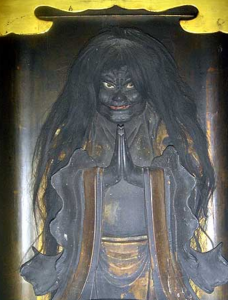
So there’s a couple of things I want to add. One is that—OK, in Japan, Kishibojin was popularized in the Kamakura era by the Nichiren Buddhist sect. There’s a temple in Chiba called Hokkekyō Temple. And there’s a carving there that is actually said to be done by Nichiren, the founder of the sect himself. I mean, that’s how important she is to them.
There are two temples in Tokyo, the main ones in Tokyo. One is in Meguro, and one is in Zōshigaya. And those I wanted to visit. I’m going to do that later when I have free time and money. So she’s still today kind of alive and well, at least in spirit. And a lot of the stuff remembered is the good stuff. So that’s one thing.
The Symbolism of the Pomegranate
One thing is that Japan, the Kishibojin was popularized in Kamakura, Nichiren. Another thing that’s interesting is a pomegranate. A lot of the carvings, paintings, you’ll find her with a pomegranate in her right hand.
One line of thought says that the pomegranate is fertility. And it represents fertility, all the seeds, right? Because she had a lot of babies. But another one—and I kind of like this one better—is her thirst for human flesh was so great, and also her helpers, which I’m going to get to next, was so great that the Buddha, in exchange for saying, hey, let’s cut down on the cannibalism right now, I will give you a pomegranate and eat this instead.
So from then on out, she vowed only to eat pomegranates. And another weird kind of funky rumor is that pomegranates taste like human flesh. Ha ha. But you didn’t know that. And I hope none of us ever find out. But I thought that’s kind of cool.
The Ten Cannibal Women
And lastly, the thing I wanted to talk about was her 10 assistants. They are called Jūra Setsunyo. One interpretation, one translation, is the 10 demon daughters. So she used her daughters. She actually enlisted her daughters to go out and help her hunt down babies. And not only hunt them down, but to torture them, and then to feed them to her children, other children, the younger ones.
They’re also called the 10 cannibal women. So not only did they hunt down babies, torture them, and feed them to their siblings, they also, I guess, partook of the delicious pomegranate-tasting flesh themselves. Again, drawing conclusions from what I’ve read.
Connection to Hindu Tradition
The 10 demon daughters, or the 10 cannibal women, you can almost see there’s an Indian tradition, Hindu tradition. There are these females. And they’re big, and they’re black, and they’re strong, and they’re really cool. And they’re called Rasetsu. And their job was to do just that, to hunt down people who have done wrong, and to kill them, and to eat them. So it’s kind of that merged with all this in a really cool way.
These 10 women or daughters were given—or they had these magical whispering powers, where they could do incantations. So I guess they swooned their way into families or whatever to get their meals. That’s kind of neat, too.
And again, when Buddha went to Kishibojin and said, hey, yo, stop it, the daughters also took heed, and they gave up their wayward ways. And they decided they would become guardian deities as well.
The Names of the Ten Daughters
I found a place that actually has a list of them and their names, these 10 daughters. And some of the names—I’m going to end on this, because they’re really neat. Some of the names are—one is Trapped or Ensnared. Another is the Spirit Snatcher. Another is Insatiable. All wonderful names. The Necklace Holder.
Mini Tresses, which I’m so going to write a short story called Mini Tresses, because I love—not mini, like tiny, but mini as in lots of tresses. Another one, Crooked Teeth or Black Teeth. And the last one that was interesting was Flowery Teeth.
So I guess if you’re going to get eaten by—caught and tortured and eaten by one of these cannibal women demon daughters, I don’t know. I think I’d go with Flowery Teeth. I’m not sure.
Conclusion: From Demon to Protector
So there you have it. This is Kishibojin. Kishimojin, she is a demon-turned-goddess, originally Hindu Sanskrit, but went into the Buddhist canon in the Lotus Sutra and made her way through China and into Japan. And she has temples and shrines as well here. And she’s really cool.
My story I wrote about her is called The Mother of All Devils, and I so enjoyed—so enjoyed writing that as well as researching it. So I’m glad I could share that with you. Thank you so much for listening.
Thank you again for listening. I’m Thersa Matsuura. You can find me on Twitter, Facebook, Patreon, et cetera, by searching for my strangely spelled name, T-H-E-R-S-A M-A-T-S-U-U-R-A, or Uncanny Japan. Talk to you soon.