Imagine that you moved into a abandoned akiya in the mountains of northern Japan. While exploring the house you discover a pair of wooden dolls tucked away. They are old, very old. Their small dusty faces peer out from beneath layer upon layer of once colorful cloth. The inner pieces are so ancient, they’re frayed and faded to gray. You can make out that one has the face of a young woman, the other a horse. They don’t look very frightening. And the truth is they are house deities that have been here for generations. A few times a year they were taken out, given new clothes, offered food, and allowed to play and dance. In return, they watched over the home.
But they DO have some rules you need to follow. One being: once you start caring for these little gods, you can never stop. Because if you do, well, let’s just say they don’t take kindly to being forgotten.
Today on Uncanny Japan we’re heading back up north for another rather disturbing folktale and the unusual traditions surrounding it. This time, we’re talking about Oshira-sama. And you get another heads up, too. The legend has some rather icky bits. But we all remember the original Grimm’s fairy tales, right? Those weren’t exactly sunshine and rainbows either. I’ll tell the tale as gently as I can.
#
Hey hey. This is Thersa Matsuura and you’re listening to Uncanny Japan. The place where I talk about all the more obscure parts of Japanese culture. Be it weird creatures, interesting superstitions, or creepy tales.
How are you hanging in there? Yeah, me, too. The end of the year is always nuts, isn’t it? Will I jinx it if I say I’m looking for 2027, the year of the Fire Goat? Yeah yeah, fire goat sounds wild, but theoretically it’s supposed to be much more mellow than *waves hands* 2026.
A wee reminder if you’re trying to find a present for that hard to buy for Japanophile, there’s: The Book of Japanese Folklore, The Yokai Oracle Deck, and Legends of Japanese Mythology (for the middle graders) by me. Oh, and I just learned, ha, that you can gift a patreon membership to someone. I’m not sure how long that has been around. But it’s a neat idea.
Okay, today’s show. I admit, coming from farther down on the map in Japan, I did not know about the Oshira-sama story until my North Before the Snow trip. I came across it while looking for places to visit. I read about these house gods and the terribly morbid legend that gave birth to them and was like, yeah, okay, I need to see the place where they’re still revered today.
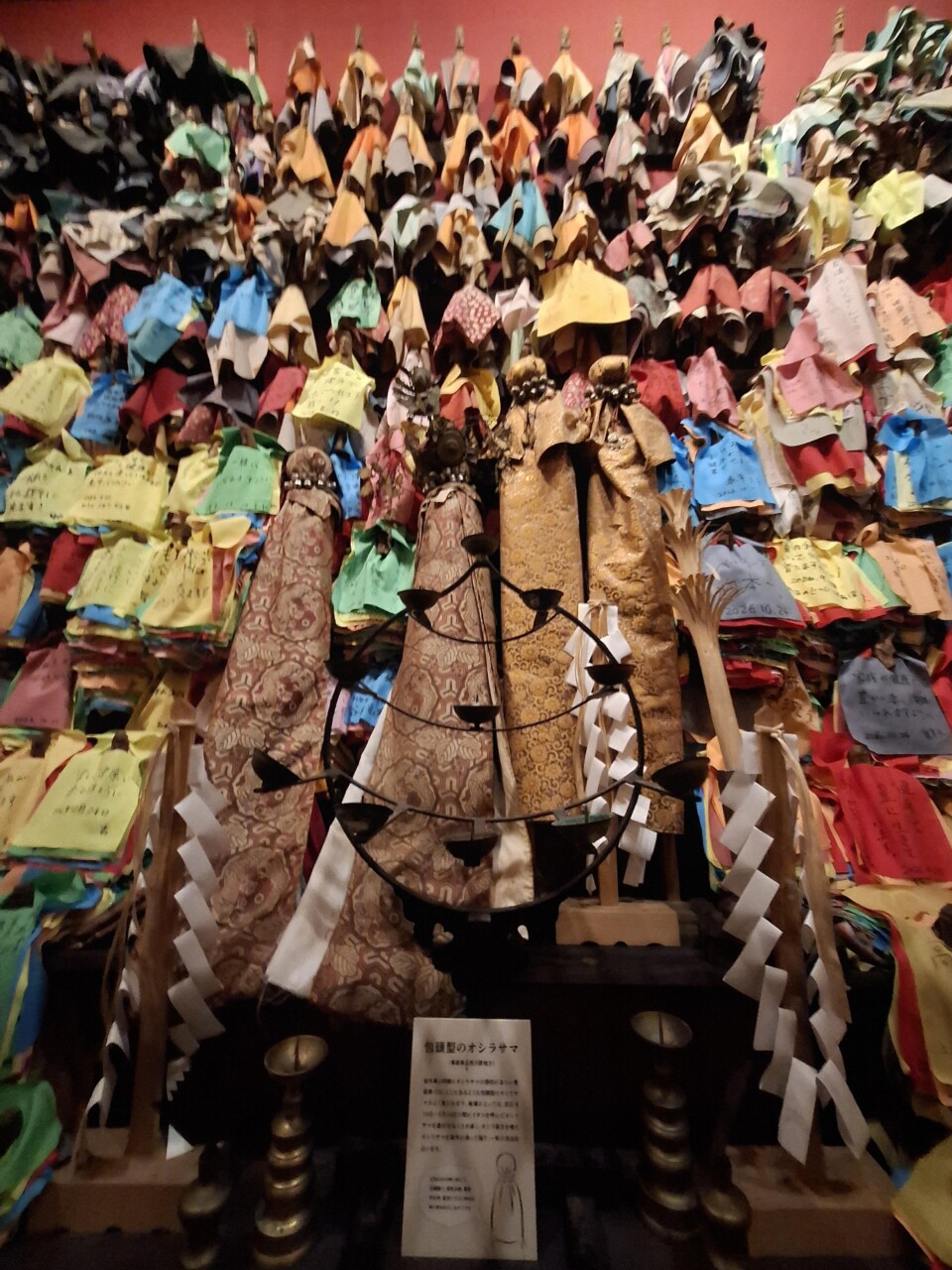
And I need to step into the OShirado hall which is basically a small room with a thousand of these colorful and a wee bit creepy folk deities stacked from floor to ceiling on all four walls. I’ll tell you about what that was like in just a second.
But first, before I just jump into the legend itself, let’s look at the name real quick. Usually it’s just Oshira-sama. The “Oshira” sometimes being written as white. Shira equals Shiroi. And sama, an honorific.
At first reading, I thought Oshira-sama traditions were only believed and practiced in Aomori and Iwate Prefectures, but have since learned they’re found in other parts of Tohoku (the northern region of Honshu) and even in some southern parts of Hokkaido. If you really dig deep, you might hear them called different names: Oshinme sama and Oshira-gami. Then also: Oshira-botoke. Botoke comes from hotoke meaning buddha, which is interesting. And finally, “Ka no ki Ningyō”, simply “mulberry wood dolls”.
So the basics: Oshirasama are household deities associated with horses, agriculture, silkworms, family prosperity and protection. They also heal women’s illnesses, take care of your eyes, and are a protector of children.
They are usually found in pairs. Imagine a long thin stick of mulberry wood or bamboo, one with a female face carved into it, the other with a horse’s head. Although, I read a man’s face is also sometimes seen. But girl and horse are the usual pairing.
Sometimes instead of carved faces, you’ll find the sticks just draped in a layers of cloth or silk. In this case a string, cord, or bells will be tied around the top to cinch the neck and make it resemble a little round head. But there’s no face.
So let me give you my impressions of them. I think what struck me most was for want of a better word just how powerful they felt. They aren’t anything like the elaborate, intricately carved Buddhist statues that I love so much and am always seeking out. Those are powerful in an entirely different way. The time, craftsmanship, and care that goes into one of those is absolutely mind blowing. With Oshira-sama, though, there’s none of that. There’s something almost primal about them. Their faces are crude, simple, almost unsettlingly so. Nothing fancy. But while they look so primitive, there is a real presence to them. Dare I say, uncanniness.
To give you an idea, maybe a handful of other people came and went while I was there at the OShirado Hall, the small, heigh-ceilinged room with all the Oshira-samas lined all along and up the walls. And at least four of them expressed feeling uneasy and that the whole thing low key freaked them out. One woman even refusing to take any photos and pulling her boyfriend from the room. Now, that might be because they heard the actual legend which would no doubt unsettle anyone who hears it. But also, the room is fairly dimly lit with red walls, and a bare tree in the middle. Surely a mulberry tree. And then you have a thousand tiny faces all staring down at you. So as a first impression, I get it.
But let me describe what a these dolls looks like again. Remember a long stick, roughly carved with the face of a girl or a horse at the very top. But what is impactful I guess is that under their little heads are layer upon layer, upon layer of cloth. All different colors. Bright reds, faded blues, floral prints, scraps of silk or cotton, all piled over one another until the little figures become these thick, almost shapeless bundles of fabric. The top pieces are relatively new, the ones at the bottom and underneath, so worn and faded they are gray and colorless. So you really get the impression of time and the generations of people who have cared for them.
I’ll have photos on the Uncanny Japan website, more photos and videos over on patreon, of course.
Speaking of unsettling. And this is a seqway into me telling you the story. Does everyone remember Kunio Yanagita’s classic book: Tōno Monogatari? The Legends of Tōno? Published in 1910? I’ve mentioned it before. In it he recorded a whole bunch of folk tales from the Tōno region of Iwate Prefecture.
Well, in the entry numbered 69 he talks about Oshira-sama. So I went and re-read it and found something pretty wild. So what he recorded was the account of a woman named Ohide. She was over eighty-years old at the time and quite healthy, he says. But he mentions that Ohide was skilled at magic and could kill snakes with spells and cause birds to fall from trees. The man who collected these stories for Yanagita was a man named Sasaki Kizen and he reportedly witnessed these feats of magic first hand. Creepy, Ohide. And doesn’t that sound like dark magic. I see no good reason to kill snakes and birds.
And Ohide’s retelling of the legend is quite disturbing as well. Although she was just repeating what had been passed down. Speaking of disturbing, I was just at the Japan Writers’ Conference this past weekend and did a very short reading and Q&A and when I introduced my story I mentioned it was a about a horse. Afterward, a nice audience member came up and said when he heard me say horse he was worried it would be the tale of Oshira-sama. To which we both made that aggrieved face.
Okay, so let’s do it. I’ve put it off as long as I can. Here’s a version of the Oshira-sama legend.
Once upon a time there was a man who didn’t have a wife, but did have a daughter. He also had a horse. The girl loved the family horse. She tended to it and eventually grew so attached that she’d go curl up in the straw of the stable at night to sleep next to it. Her love for the animal grew so strong that she ended up marrying the horse. *platonic*
Well, her father discovered this and flew into a rage. While his daughter was away one day, he goes and kills the beloved horse. And then he hangs it from a mulberry tree. His daughter comes home, asks where it is, learns what happened, and runs to it. As you can imagine, she’s inconsolable, weeping and holding tight to her friend, uh, husband.
But her father’s not done. Seeing this makes him even angrier. So he — let’s try to be as delicate as we can here — removes the creature’s head with an ax. But his daughter leaps onto the severed head and clings to it. Then, suddenly, magically, divinely, together her and the horse head fly up into the heavens.
It is said that at that moment a new god was born. The Oshira-sama.
But wait there’s more. This is kind of an epilogue that appeared in a separate text called Kikimimi Sōshi.
Some time after she ascended into heaven the daughter appeared beside her parents’ pillow one night. Yes, the original says no mother, but here it specifically says “parents”. Anyway, she told them to raise silkworms in a mortar, and to feed them mulberry leaves.
Side note: As someone who did a lot of research on raising silkworms for one of my stories in Dark Tales from Japan, it sounds like pretty much mulberry leaves are the only thing the little creatures will eat. They are very picky eaters.
So her parents ended up following her advice and were able to raise silkworms, and thus silk. And this is said to be the beginning of sericulture in Japan.
And I must add that in another version of the legend, the father instead flayed the horse. But then after he did, the skin flew up, wrapped itself around the daughter and took her up into heaven.
Remember all the good things Oshira-sama worship does? Home, eye, and child protection, help with agriculture and your silk worms? Well, back in the day they also helped hunters. Remember that Oshira-sama are basically two sticks. So in order to decide which mountain they should go hunting on, hunters would borrow the girl-headed and horse-headed rods to do a little Oshira-sama dowsing. I didn’t quite understand how they held them, but basically wherever the horse’s head came to point, that was the mountain with all the game on it.
And this is interesting, because from this, there’s a line of thought that says: maybe oshira-sama is from Oshirase-sama. Oshirase meaning to inform or give notice. “The deity who informs”. Which makes sense and would be a deity you’d want to be on good terms with.
And that holds up with a couple other things Oshira-sama can do, which is predict earthquakes, fires, and other disasters.
So they are quite powerful. They’re doing a lot. But … and there’s always a but…there are a couple things they really do not like and can get you into big trouble with them if you’re not careful. So let’s go over those. The Oshira-sama worship taboos.
For one, Oshira-sama dislike the meat of two-legged and four-legged animals. Also, eggs. Yuck. No eggs. So you should never offer such foods to the Oshira-sama. Which is a little bit contradictory since just a moment ago they were telling you where to literally hunt in the mountains.
But anyway, it’s better to play it safe. Because it’s believed that if you do break this rule, some divine punishment will befall you, like a serious illness, or perhaps your face will end up twisting and distorting until you’re unrecognizable.
It’s also said the family who have Oshira-sama in their home, should also not eat meat. Same outcome: divine wrath and a scary, twisted face.
Another thing to be careful of, if you start worshipping Oshira-sama you must continue for the rest of your life. If you treat the deity carelessly or disrespectfully, or forget to honor it, misfortune and punishment befall you and your family, as well.
But don’t let those get you down. Oshira-sama can be fun. They must be entertained. So on certain days of the year this is done. These dates if you’re taking notes are the 16th day of the first, third, and ninth months of the old lunar calendar. I think I read another couple other dates as well. Seriously go find those. More and more it’s feeling like you shouldn’t piss the Oshira-sama off. Err on the side of more worship.
On these special days the pair are taken down from the altar and dressed in additional layers of new clothing. This is called osendaku. There’s a sacred narrative that also needs to be recited, usually by the oldest female in the household.
Then the young girls in the house are allowed to play with the Oshira-sama sticks, carry them around — I don’t know, Japanese tea party? — for the entire day. Of course, non meat offerings are provided, too.
Sometimes blind shamans called itako are invited to participate in these ceremonies. In this case, the itako will recite some sacred invocations while she “makes the figures dance”. This is called “Oshira Asobase”, “letting them play”. Basically, the itako holds one figure in each hand and shakes and waves them around. And be forewarned, she might very well fall into a trancelike state while doing this as well. Lordy.
Then~ I found there’s another tale related to the Oshira-sama. Totally different and this one not disturbing like that first one. It’s from Tsugaru.
Long ago, a blind traveler spent the night in an abandoned house on a mountain pass. To relieve his loneliness, he began to sing. As he sang, he heard a woman’s voice asking him to sing for her. He obliged, singing several songs to this mysterious woman.
Around dawn, the woman told him that her name was Tako. She warned him that if he ever told anyone about her, he would lose his life. The blind said he understood. Tako presumably left and the traveler descended from the mountain and reached a village.
There, unable to keep the strange encounter to himself, he told the villagers what had happened the previous night. As soon as he finished telling his story, he dropped dead. Then Tako herself appeared.
She warned the villagers that anyone who spoke of her to anyone else, outside that village, would die. Then she added, that if her existence were revealed at all, the entire village would sink beneath the waters of a swamp.
Terrified, the villagers erected an iron fence around the mountain pass. By doing this, they prevented Tako from returning to her home on the mountain. Unable to return, she died. Only then was her true identity revealed. Tako had been a snake. The villagers subsequently enshrined both Tako and the blind traveler as deities.
According to this tradition, these two figures eventually became known as Oshira-sama.
I love that story for so many reasons.
One. My first impression here is it reminds me of the old Joro Gumo (Harlot Spider) and Yuki Onna (Snow Woman) tales. Meet a woman, she tells you not to tell anyone about her, you do anyway, then you suffer something terrible. Usually death.
Then I thought, hey, maybe this is why Ohide was killing snakes earlier with her magic spells. Hmm? Then I thought, how delightfully whacky was it for the villagers to built a fence to literally trap the scary woman who just killed a blind man IN THE VILLAGE WITH THEM. But they’re smarter than me, because it ended up working out for them, so…
Back to the Oshirado Hall. Despite all I’ve said about the feeling of primal power and others being a little off put by the thousand dolls in that little room, you could pay a some money, take one of the many colorful pieces of cloth piled up on a table and using one of the magic markers there, offer up your own prayer. This was much like the horse votives you see at temples.
But here, you write your wish or prayer on the cloth. It has a small cut at the top, so when you’re done you choose one of the (again) hundreds of Oshira-sama sticks and place it over the head, on top of the many, many pieces of cloth underneath. It was all very colorful, except toward the top of the room where the figures were obviously very old and the fabric all gray and frayed. But it was nice to see people praying for world peace, health, prosperity. So in the end, my impression of the little figures was a good one.
Now let’s end on a bit of weird trivia. If some of you are listening and thinking that Oshira-sama sounds familiar. And if you happen to be a Studio Ghibli fan, you may have already met one. Remember that enormous, white rather rotund character in Spirited Away? The one wearing only a red fundoshi and a red lacquered bowl on its head. It rides with Chihiru up the elevator? That’s also called Oshira-sama!
In English he’s usually called the Radish Spirit and he does look like a giant daikon radish. I guess even in the storyboards that’s how he was described. But for some reason Miyazaki Hayao named him Oshira-sama? Why? It doesn’t look anything like what we’ve talked about today. And I can’t find a reason for it either, except some suggestions Miyazaki Hayao might have just borrowed the name from the existing folk deity and then reimagined the appearance.
Hints being: Oshira-sama is associated with agriculture. And a daikon is a root vegetable. So agriculture? Also shira as I mentioned earlier is sometimes written as white, and a daikon is white? I really can’t find a good explanation as to why Ghibli’s Oshira-sama looks nothing like the traditional ones. Does anyone know? Let’s make a deal, if any of us ever meet Hayao-sensei we’ll ask him.
Okay, my friends. everyone take care, stay safe out there, and I’ll be back to talk to you in two weeks.