Imagine you’re traveling alone through the Japanese countryside. It’s getting dark, starting to rain. You’re exhausted, cold, hungry, and there’s nowhere to stay. Then, just ahead, you see a small dwelling tucked among some large rocks. An old woman appears. She smiles and invites you inside. She offers you something to eat and a warm place to sleep for the night. You can’t believe your luck. And that’s your first mistake.
Today’s episode is about the legend of the Demon Hag of Adachigahara. I’ll tell you the local folklore, some variations, a mysterious poem about a black burial mound, and my own visit to both the demon hag’s dwelling, blood pond, and that black grave. The lore itself has this one quite disturbing element to it, so if you don’t do disturbing you might want to give this one a pass. But you DO do disturbing, keep listening.
Opening:
Tadaima~ Guess who’s back? Me, it’s me! I’m back. Wow. I’m not going to talk your ear off — because I could, I have so many stories — but I’ll just say my little two-week-long road trip (North Before the Snow) exceeded all my expectations. One of my mottos was do the hard thing and I did. Some things were harder than others, but doing them felt good. Scary, but good.
Another thing is that I really wanted to be alone (like, more alone than my usual alone), but I realized the first day while visiting a wolf shrine in the mountains, when I started chatting with a couple hikers from Saitama that, no, actually I DO want to talk to the local people and learn stuff.
So every place I visited I met at least one person, usually more, had delightful conversations, made connections, and learned a lot. The older woman who ran a very nationalistic-looking war museum blasting WWII military songs with old propaganda posters, tanks, guns and the wings of a Zero fighter outside — yes, I absolutely stopped there (very hard thing) — we talked for an hour or so, got along great. And she told me things about WWII that really messed me up. Like forever. I thought I knew some terrible shit. But anyway I spent the afternoon all by myself wandering that museum of sorts. I lit some incense and prayed for peace in front of a battered Kannon statue and a small hand brushed sign that read: Right now, all the people who have died in war are intently watching you.
You know that old storytelling trope that became a meme: “The real treasure was the friends we made along the way”. The whole time, I kept thinking, ha, it’s true! Like how one very early morning, I fell head over heels in love with an Edo Era sculptor/carver/artist named Ishikawa Unchō. At the same time there was this other older fellow also flittering around like me: mouth open taking photos. We started talking and after a couple hours he invited me to follow him deeper into the mountains to visit a smaller temple with more of Unchō-sama’s artwork. And I went! It was fine. I don’t usually follow strangers into the hills.
Also, every place I went just happened to be a power spot, or maybe that was just me, but my gosh the trees, the boulders, the rivers, the mountains, the solitude, the good energy. Mind blowing. So, I’m home processing and reflecting and going through all the photos, videos, audio files, and booklets and books I picked up. So stay tuned for more folklore, legends, and myths that I dug up on the trip.
Like today! Today’s episode is about the quite disturbing legend of the Onibaba of Adachigahara. And like I always say: there are quite a few versions that have cropped up over the centuries and I’ll talk about several of those. But first…remember ad free episodes and extra content are over on my patreon page, now let’s talk about this monstrous oni hag. Like where did she live? I went there, actually.
I arrived late afternoon. It’s raining; low, heavy, drizzly skies. I’m pretty sure I haven’t seen a person in hours. Even now, I’ve parked and am walking to the temple, but the whole place is deserted. There’s not even anyone to take the four yen admission fee to the temple grounds. The area is semi rural, flat. There are scattered houses and farms, narrow windy roads, and a river nearby. I leave the money and walk through the gate and immediately to my right is a pile of very large stones. They’re oddly shaped and stacked weirdly, too. So this is it. This is the place where the legendary onibaba actually lived. My immediate impression is that the whole jumble of rocks feels totally out of place on this flat plain. Where did they come from? They seem much too big to have been hauled here. And there are no mountains nearby that they could have tumbled down and no other similar stones that I could see anywhere around. Also, it’s not like a cave. It’s a bunch of large stones with one precariously balanced on top. That one is called the kasa ishi or umbrella or hat stone, by the way.
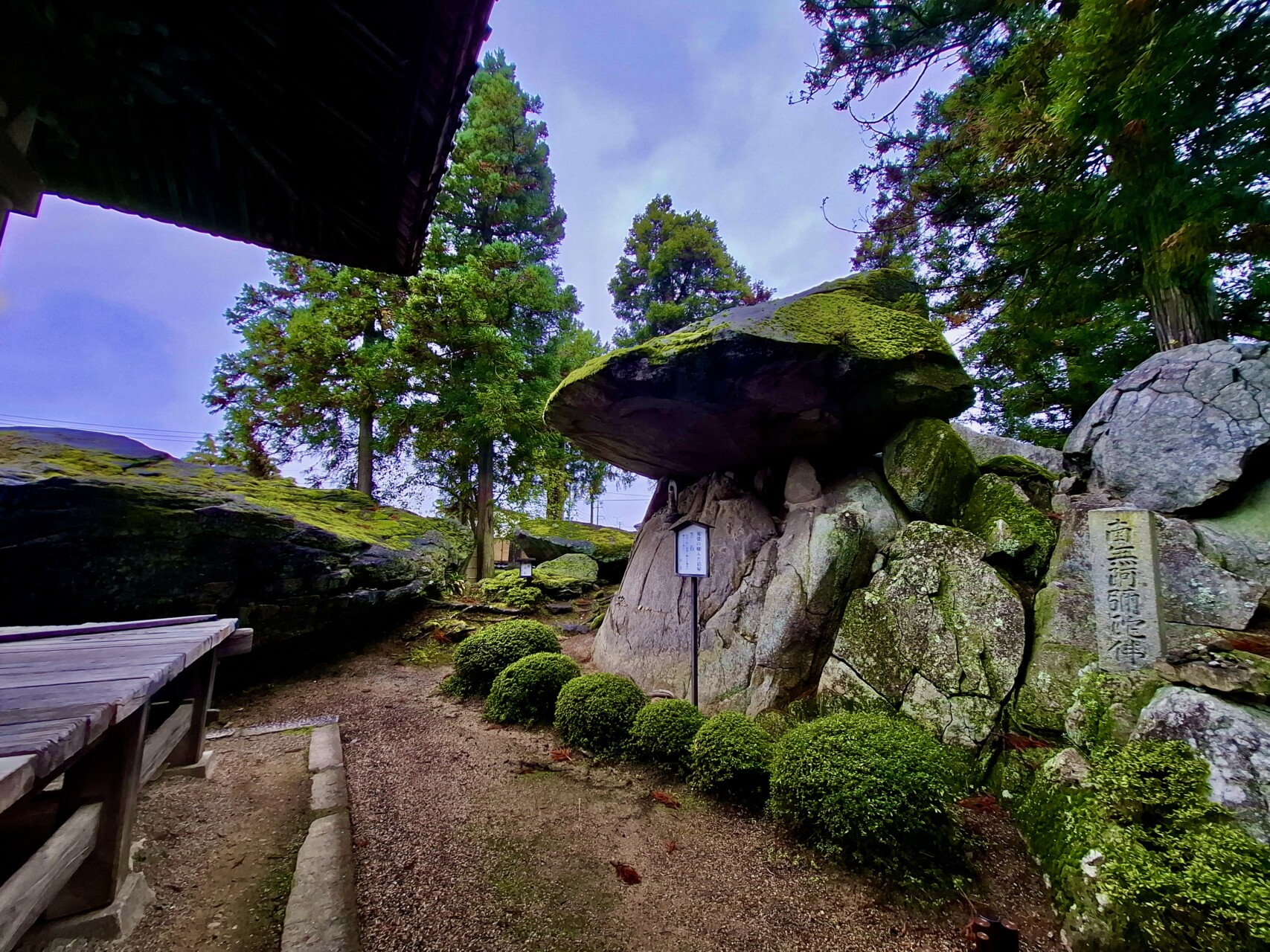
After coming home, I looked it up and I’m not the only one with that thought. A certain Professor Masao Fukazawa wrote some essays about this place and the legend, and said basically the same thing: why on earth does such a formation exist on this particular spot?
Anyway, I’ll put a couple photos up on the Uncanny Japan website so you can see what I’m talking about. Over on Patreon I’ll go ahead and post a bunch more. Because I took loads.
So that spot is called Onibaba no Iwaya / The Demon Hag’s Rock Shelter. My guess or I imagine that there was a small hut built next to the stones because there is no “inside”. It’s just rocks. So a small several roomed shelter would make sense.
Now next to that, there is a tiny pond. It’s called Chi no ike / The Blood Pond. Nice. And this is where the Onibaba is said to have washed the blood from her knife after murdering her victims. What great imagery. Now it is covered in a thick green carpet of algae. Very spooky.
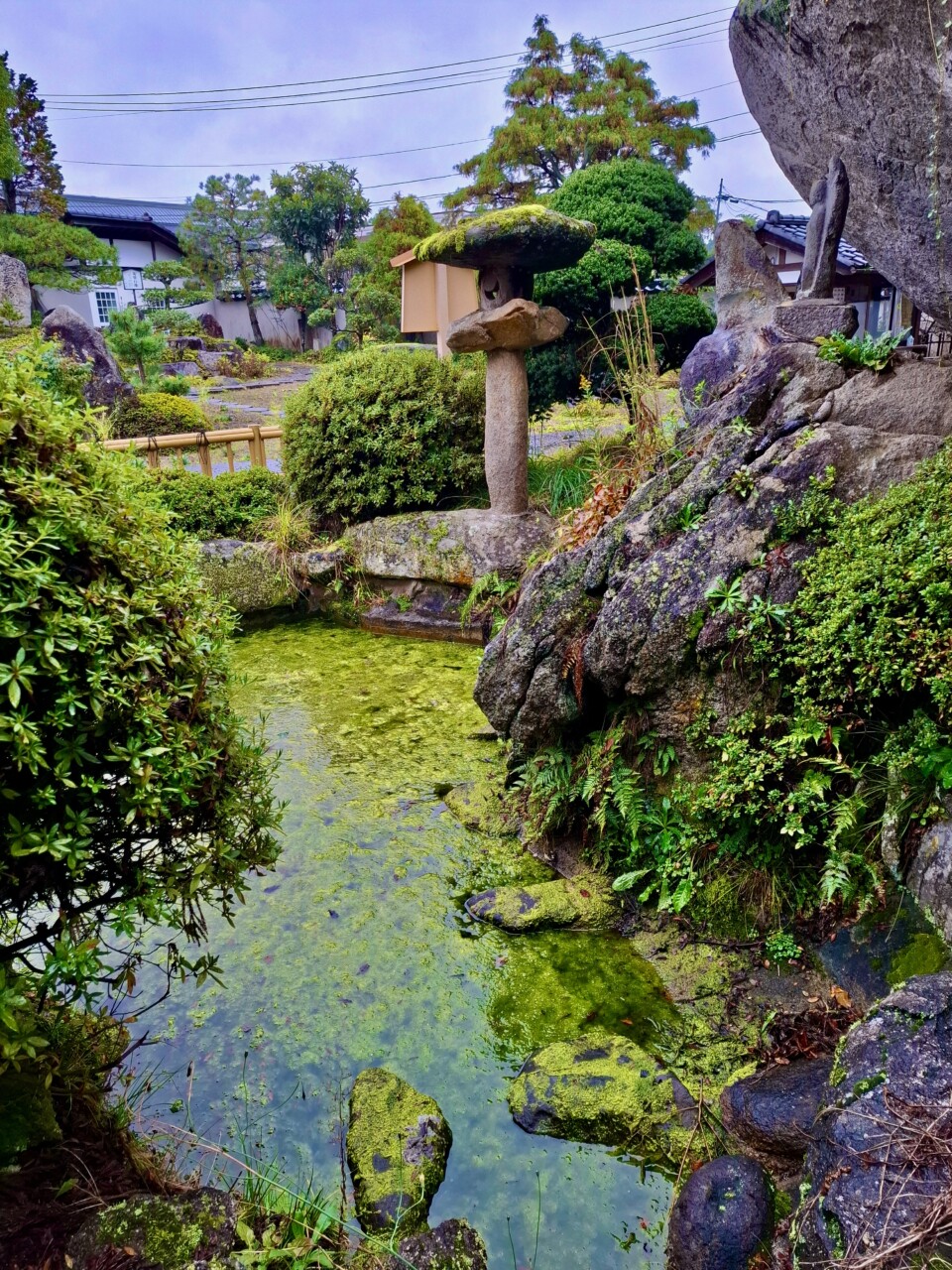
Her actual grave is off the temple grounds and a bit of a distance away. I’ll get to that, but first — because you’re dying to know — let me tell you her story. Before I get into the Noh play about this onibaba — which is a different version of her tale — let me tell you the local legend first.
Long long ago, Adachigahara was a peaceful and lonely expanse of silver grass along the Abukuma River. There among the pines and cedars, beneath an outcropping of enormous rocks, lived an elderly woman named Iwate. But she had not always lived there.
Years before, she had worked as a nursemaid to a high-ranking princess in Kyoto. The princess who was only five years old had been unable to speak since birth, and despite every effort and every doctor, no one could help her.
One day, a fortune-teller gave the family a terrible solution to their problem. If the young princess consumed the fresh liver of an unborn child, she would recover. Iwate was determined to save the little girl. So she gave her own daughter a special charm to keep her safe and left. She then set off, traveling far into northeastern Japan, looking for this disturbing cure.
But how could she ever obtain such a thing? Many, many years passed. Iwate was now old. But still she waited until finally, one autumn evening, a young couple appeared outside her rocky dwelling. The husband said his wife was heavily pregnant and suffering from stomach pains. He begged that they might stay there for the night. Iwate, of course, welcomed them inside.
This was the opportunity she had been waiting for. When the wife began experiencing severe pain again, Iwate urged her husband to go to the village for medicine.
Then after he was gone, she attacked the young woman with a knife to get what she had been told she needed.
But then the most unexpected thing happened. With her last dying breath, the young woman asked the old woman to deliver a message. She said that if she should ever encounter someone named Iwate, to tell her that her daughter, Koigoromo, had died. She handed over a protective charm that the old woman immediately recognized. She had just murdered her own daughter. And her grandchild. This was the girl she had left behind all those years ago.
Iwate staggered out from her rocky shelter, her long white hair tangled, eyes wild. She stood beneath the pale moon trying to make sense of what had happened, but it was of no use. Her mind was completely shattered. That night she went mad and that madness transformed her into the Onibaba of Adachigahara. Side note: the husband returned, saw what happened, and committed seppuku right there on the spot.
As the years went by, Iwate, now onibaba, stayed there among the rocks in her little house, being creepy and waiting for some unsuspecting person to come along. When they did, she’d lure them into her hut where she would kill them, eat them, then wash her knife in her little pond. She had a system. Of course, the rumors began to spread about the terrible old hag who lived alone and caught and dined on travelers. The locals stayed away, too frightened to even go near her dwelling.
Then after several more years, on one late autumn day, an elderly Buddhist monk was passing through and looking for shelter. His name was Yūkei (祐慶), new to the area, and Iwate graciously offered him lodging.
She said she’d make a fire and cook a hot meal for him, but before leaving to gather firewood, she warned the monk not to look inside the back room. Yūkei, no surprise, waited until she was gone and looked. There inside lay a horrifying heap of human bones, skulls, rotting corpses, blood, pus. Yes, the pus is in the story. And that’s the moment when the monk realized he was staying at the infamous Onibaba’s place. Before she could return, he grabbed his stuff and fled.
Iwate got back, figured out what had happened, and went after him. Demon hag’s are fast and very good at tracking their prey. She quickly found the monk and began gaining on him. Yūkei realizing that there was no escaping, took the Kannon statue he just happened to be carrying with him and set it on the ground. He fell to his knees and began praying desperately.
Suddenly, the statue rose into the air and from the white bow in Kannon’s hands, a golden arrow flew straight into Onibaba’s chest.
But she doesn’t just fall over dead, she also — through Kannon’s compassion — is released from her infernal suffering. The villagers buried the onibaba at what is now a memorial mound called kurozuka or the black grave.
The end.
But there are so many variations. Some say it was a pregnant woman traveling alone on a stormy night and she went into labor and sought shelter. Or that the woman didn’t tell her to pass the message along, Iwate found the charm herself and realized what she’d done.
In one version the Onibaba is struck by lightning. In another she isn’t killed at all. Instead she repents, becomes a follower of Buddhism, and eventually becomes a respected female monk. And in another the priest doesn’t accidentally stumble across her, he’s sent to hunt her down and subdue her. In this version he chases her around Japan for a while, wounds her once, but she manages to escape. Finally he gets word of where she is, and pursues the onibaba until he ends up cornering her and successfully killing her by cutting off her head.
Which was unnervingly preserved and kept in a special Buddhist hall that Yūkei built for just that purpose. So in this version, her body was buried at the black grave where a cherry tree was planted. A cherry tree that grew into a magnificent tree and produced beautiful blossoms every year. And that “preserved” head was kept at a temple called Tōkōji. This seems to be in Miyage Prefecture. Now don’t get any bright ideas, the temple was eventually abandoned or moved and has basically ceased to exist all together.
The skull or I don’t know was the preserving of the head good enough that we can just call it that? Let’s pretend it was. The severed head was said to have been passed down from generation to generation in the Adachi family. Now let’s imagine that scenario. Did they keep it somewhere that all the family could see? offer incense daily? Or was it handed down in a ritual? Maybe old grandpa on his deathbed calls his grandchildren over. Hey, Hiroyuki, about your inheritance, I don’t have much money, but can you go bring me that box over there? Yeah, that one. Go ahead and untie those cords. You’re never going to believe this…
Also, I actually know someone named Adachi, so we’re going to have to have a talk.
So how long has this story been around? It’s a little confusing, but really quite fascinating. It looks like the earliest written record of an oni woman living at Adachigahara is more than a thousand years old!
And it came in the form of a very short poem by Taira no Kanemori (who died in the year 990). He was considered one of the Thirty six great poets and was a member of the imperial family. So he wrote this little poem for either the daughters of the son of Prince Sadamoto, or to the sisters of Minamoto no Shigeyuki. Depends on what you’re reading. But what matters is it was sent to young women who were living in the Kurozuka of Adachi Moor area.
The poem goes like:
Michinoku no
Adachi no hara no
Kurozuka ni
Oni komoreri to
Iu wa makoto ka
In Michinoku
On the moors of Adachi
Within the Black Mound
Some demons live in hiding
They say, but can this be true?
And what’s important here is when he talks about demons or oni living there he’s teasingly referring to the girls — young women — I don’t let’s pretend they were over eighteen, as oni. I guess that was a thing. Also, it seems to have been a cheeky kind of love poem and he did want to marry one of them but mom and dad said too young.
Then for five hundred years there wasn’t any talk of oni living in the Adachigahara area.
Whether or not that poem was inspiration for the Noh play or not, I don’t, ha, know. But a play was written. And what’s fascinating is that here the onibaba isn’t just some bloodthirsty monster. She’s lonely. She’s suffering. And she’s trapped in her miserable existence. And then she welcomes some yamabushi (not a single monk, but several) into her home, she asks one simple thing of them (don’t look in that room), and what do they do? Betray her. Now I’m not excusing the mountain of bones and blood and pus. But this does seem to be a more sympathetic version of her tale.
There are also puppet plays about the onibaba that focus more on Iwate and the murder of her daughter. And then a kabuki play called Kurozuka that is also sympathetic toward the demon woman. A kabuki version that came about in 1939, has a scene where the onibaba dances joyfully in the moonlight after hearing that Buddhist salvation might still be possible for her. But then she discovers that her guests have betrayed her and looks into that room and she loses her mind again and well, stab stab stab eat eat eat. I actually like that version, story wise.
There are also onibaba legends elsewhere in Japan, some claiming to be the original. And there was even a period at the start of the Showa era where people were arguing over which version of the tale was the real one.
Don’t forget the 1964 horror flick called Onibaba and a manga that appeared in Shonen Jump. But I think what has resonated most with me about this legend is the artwork by Tsukioka Yoshitoshi. Maybe you’ve seen it?
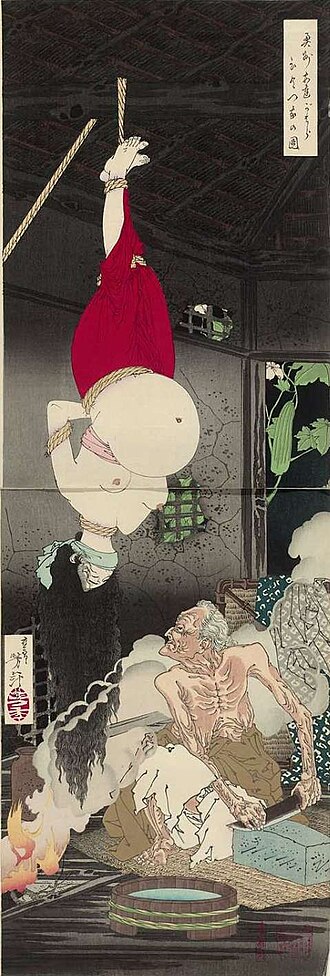
I remember seeing it for the first time many years ago and being rather shocked. And I just learned it was banned by the Meiji government for “disturbing public morals” Yeah. I can see why someone might say that. It’s the image of the onibaba herself sitting on the floor sharpening her knife and looking up where she has hung upside down a pregnant woman. Oof Tsukioka. Another black and white image by Toriyama Sekien has her by a spinning wheel, all crone and terrifying-like with a severed arm that she seems to be fixing to take a bite out of. Oof. Toriyama.
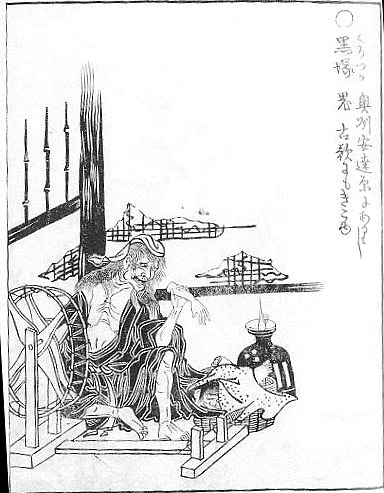
So depending on which story you’re listening to or watching Adachigahara’s Onibaba is either a blood thirsty monster, a tragic figure, or both.
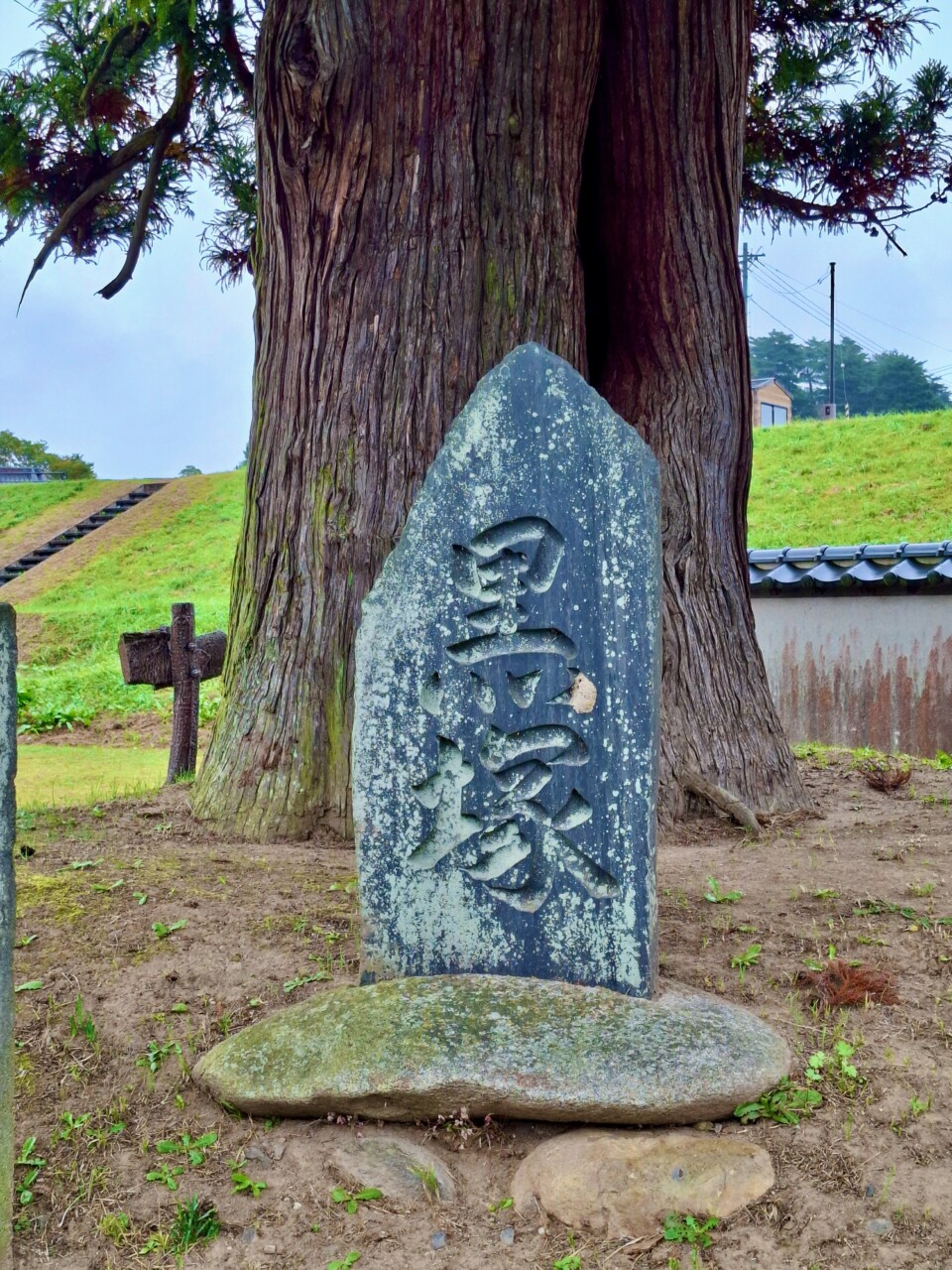
Now. I did visit the kurozuka, black burial mound, a small grave under a big tree near the river. It was nice. No bad vibes. But one thing I didn’t do while I was there and might possibly be my one regret, is visit the restaurant that served onibaba curry!
It’s called Onibaba debāgu curry. It’s a pun on deba (butcher’s knife) and hambagu, hamburger steak. Debagu. So imagine this: the hamburger steak is shaped like a knife and sits on a little mound of rice in the middle of the bowl. It separates two curries. On one side is regular brown curry, and on the other side is a red curry. A hardboiled egg has been cut in half and made to look like two eyeballs, one floating in each of the curries. But before you eat it, you get to use ketchup to decorate the meat knife with as much blood as you want. Brilliant.
I really can’t believe I drove half way across Japan to visit the site of this legend and forgot to check around to see what’s on the menu. But re-creatable, I’m sure.

Thank you all for listening. You can support the show by leaving a review, picking up Legends of Japanese Mythology for your middle schooler (or you), or if you want dark horror stories like today’s you can preorder Dark Tales from Japan. Come out in March. It’s thirty of my original tales or reimaginings of a couple existing folktales.