

Uncanny Japan logo

Category: Japanese Holidays 

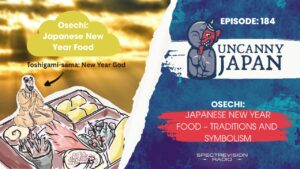
Osechi: Japanese New Year Food Traditions

Let's talk about food and folklore and so many New Year traditions. One of the most interesting to me when I first came to Japan and experienced Oshōgatsu with my in-laws is osechi-ryōri. This special, beautiful, and symbolic New Year cuisine is served in beautiful lacquered boxes called jūbako.

Joya no Kane: Japanese Temple Bells Ring Out 108 Sins at New Year (Ep. 139)

Here it is, the end of 2023, and I'm feeling that reflective anticipation we all get around this time. This is the last show of Season 7, and I'd like to take you up into the hills to my local temple, where I've spent every New Year's Eve for the past 25 years, or more.
Artist's hand drawing a serene Japanese landscape with a bell tower and rising sun, symbolizing 'Joya no Kane,' a traditional end-of-year bell-ringing ceremony, on a sketchpad, with watercolors and a brush, against a backdrop of artistic tools.

Shochikubai: Pine, Bamboo, Plum and Samurai Shade (Ep. 138)

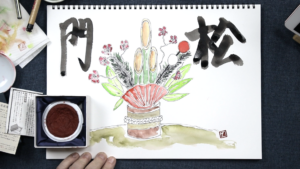
Shochikubai means "pine, bamboo, plum" and are considered the three winter friends. You'll find them in New Year decorations as well as another interesting and surprising place. I'll tell more on today's show.
Traditional Japanese shochikubai painting with calligraphy on a sketchpad, featuring plum blossoms, pine, and bamboo, the symbols of perseverance, longevity, and flexibility, alongside an ink stone and brushes, indicating an artistic setting.

Six Japanese New Year Rules: Ancient Oshōgatsu Taboos (Ep. 115)

Imagine living in an older Japan where life is really hard. No FamilyMart to grab dinner. No vending machines. The toilet's outside in the cold and dark. But you're allowed to enjoy January 1st, 2nd and 3rd in absolute and exquisite peace during oshōgatsu, the New Year's holidays. Oh wait though, there are a couple rules.
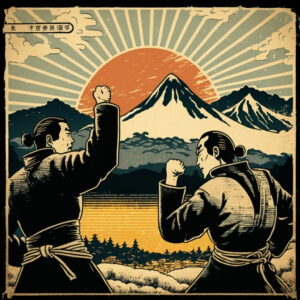
Ukiyoe image of two men fighting with Mount Fuji and rising sun in background

Enjoying the Luck of the Seven Lucky Gods (Shichifukujin) (Ep. 68)

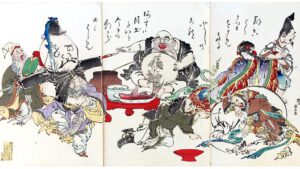
In Japan the Shichifukujin or Seven Lucky Gods appear in a boat on the first day of the year to impart various kinds of luck on those they deem worthy.
Shichi Fukujin (Seven Lucky Gods)

Toshikoshi Soba: Breaking Off the Pain of 2020 with Noodles (Ep. 66)

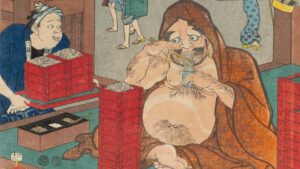
Toshikoshi soba is the Japanese tradition of eating soba noodles on New Year's Eve. It's a custom that has continued since the 1700s. There are quite a few reasons why, some have to do with long life, wealth, and breaking off all the hardships from the previous year.
Show Daruma Eating Soba

Bon Odori: Dancing with the Dead (Ep. 58)

Bon Odori or Bon Dancing is a summer tradition held all over Japan. It's a chance for families to get together and have an enjoyable time dancing to the rhythmical music. Seeing as how the Obon season is also when ancestors visit from beyond the grave, they, too, can take part in the festivities if they wish.
Bon Dancing

Star-Crossed Lovers (Tanabata) (Ep. 55)

Tanabata is a Japanese festival based on the bizarre tale of two star-crossed lovers, Orihime and Hikoboshi. I'll tell you their story and explain a little about the origins and how it's celebrated today.
Tanabata ukiyoe. Japanese woodblock print of a woman in traditional attire hanging paper decorations on a bamboo tree.
1 2

About The Uncanny Japan Podcast

Speculative fiction writer, long-term resident of Japan and Bram Stoker Award finalist Thersa Matsuura explores all that is weird from old Japan—strange superstitions, folktales, cultural oddities, and interesting language quirks. These are little treasures she digs up while doing research for her writing.

© Copyright 2025 Uncanny Productions
Buy Me a Coffee at Ko-Fi