We’re about a week away from the time of year in Japan when the boundary between the living and the dead grows thinnest. Obon.
For a few summer days, the spirits of the ancestors return home. They’ll come riding in on cucumber horses attracted by the small guiding fires lit outside homes all across the country. You know, because you don’t want great grandpa Takanori getting lost and ending up at your neighbor’s house. They never got along anyway. That’s a thing, too, by the way. I’ll talk about that in the episode.
In order to make these spirits’ brief visit even more comfortable, family altars are cleaned and decorated with flowers, fruit, lanterns, incense, and all manner of fancy food. Grandma, grandpa, great grandma, great grandpa, as far back as you’d like all gather to enjoy this cozy ghostly family reunion. That is until the end of obon, when they’ll be seated gently and lovingly on their eggplant cows and sent back to the underworld — or the Other Side — there they’ll toil, or rest, or faithfully watch over you from afar until next summer when they visit again.
Nine years ago, I did two short episodes about these Obon “Festival for the Dead” traditions. But this year is the first time in my thirty-six years of living in Japan, when I’m not just researching for the show. Now I’m taking care of my father-in-law’s altar, and I’m doing it all myself.
So follow my little bonfire, my non-spirit friends, come join me as we learn about how to welcome the dead home, what can go wrong, and how to make those veggie horses and cows.
Intro: (books are affiliate links)
Hey hey, this is Thersa Matsuura and you’re listening to Uncanny Japan. The place where I talk about all the more obscure parts of Japanese culture. Dig a little deeper into weird creatures, interesting superstitions, and creepy tales.
And, just your bimonthly reminder that my children’s book Legends of Japanese Mythology and my full-on horror short story collection Dark Tales from Japan are both excitedly waiting for your pre-order. If you’re interested that is. And if you already preordered, this is me giving you a virtual hug. Legends comes out in early September (next month!) and Dark Tales in early March, 2027, next spring. Thersa Matsuura is the name to search for, or ask your bookstore seller about, or encourage your librarian to look up.
More content and ad-free episodes on Uncanny Japan’s patreon page as well.
And before I forget, the lovely super Japanese summer background sounds are brought to you today by the cicada miserable in the heat behind my house, which coincided with a very long, low grumbling, heat thunder and lightning thing. So pull out your folding fan, slap some ice in that green tea your holding, and let’s get on to today’s show.
Pod:
First, let’s start with: Has everyone heard of Obon? It’s often translated as the “Festival of the Dead” or the unwieldy “annual Japanese holiday that commemorates and remembers deceased ancestors.” It’s a pretty big deal here in Japan, so let’s do a quick catch up on what and when and kind-of why it is, before getting into some of the actual rituals and traditions.
What it is:
Let’s go back to the time when the historical Buddha was walking around and giving really interesting lectures to his followers. Well, he had a disciple named Mokuren who was really upset because his mother had died, and using his mysterious powers, he could see that instead of being reborn in, say heaven or some place nice, she was now in the realm of the hungry ghosts and suffering terribly. So Siddhartha Gautama (AKA: the Buddha) listened to his woes, gave advice about making offerings, which was done, and then when Mokuren took a peek again, he was able to see that his mother’s suffering had ended. Wew! Thank you, Buddha.
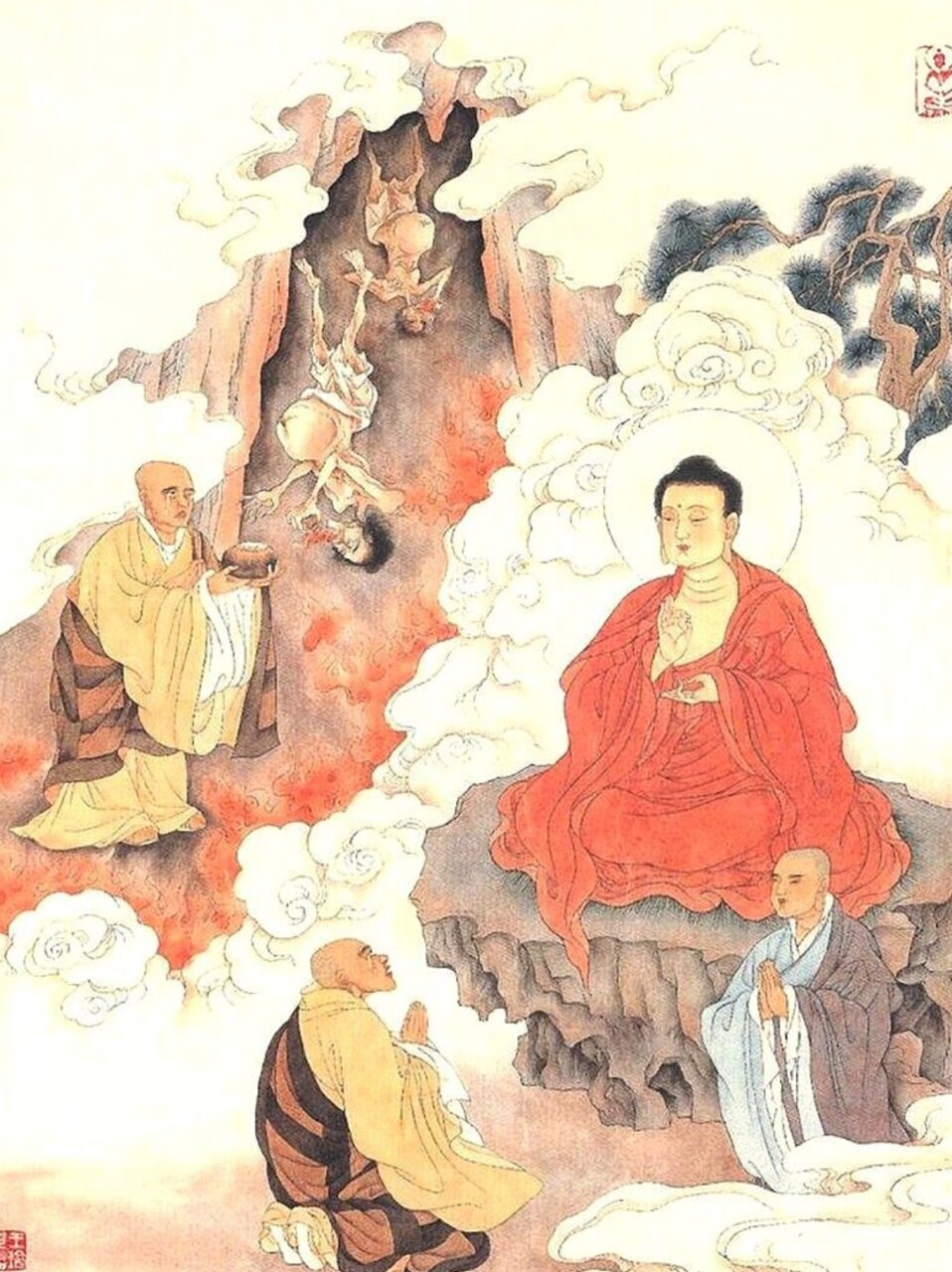
A little extra part of the story says that Mokuren (and possibly some other monks) were so happy that they began to dance around. And that this was the very first Bon Odori. Everyone knows bon dancing, right? From the Ghibli movie Pom Poko or Karate Kid 2. Bon odori is also traditionally practice during this time of year in cities, towns, neighborhoods, and kindergartens everywhere.
Interesting about the word obon. In Japanese it comes from the Urabon-kyo or Urabon Sutra – a prayer that tells the story of Mokuren and his not-so-saintly mum. There are different theories as to the origin of the word. One which is especially fun, says it comes from the sanskrit word “ullambana” which means “to hang upside down”. Because when you’re a soul suffering in hell or with the hungry ghosts (like Mokuren’s mom) there’s a pretty good chance part of your daily torture schedule will involve being hung upside down.
But then there is the Buddhist scholar Takakusu Junjiro who says, Nope, it’s a corruption of a Pali word that means “raising up, saving, or helping.” Not sanskrit at all. And, yeah, that would make more sense.
Next question! When is it? Not easy to answer, actually. Mostly, it’s safe to say: August 13th through the 16th. Four days. But you’ve got your regional differences; and then you’ve got your old lunar calendar compared to the modern Gregorian calendar which moves everything forward by a month. My city actually adheres to both calendars depending on the area or family and how they want to observe it. So July 13th to 16th or August 13th to 16th, or thereabouts.
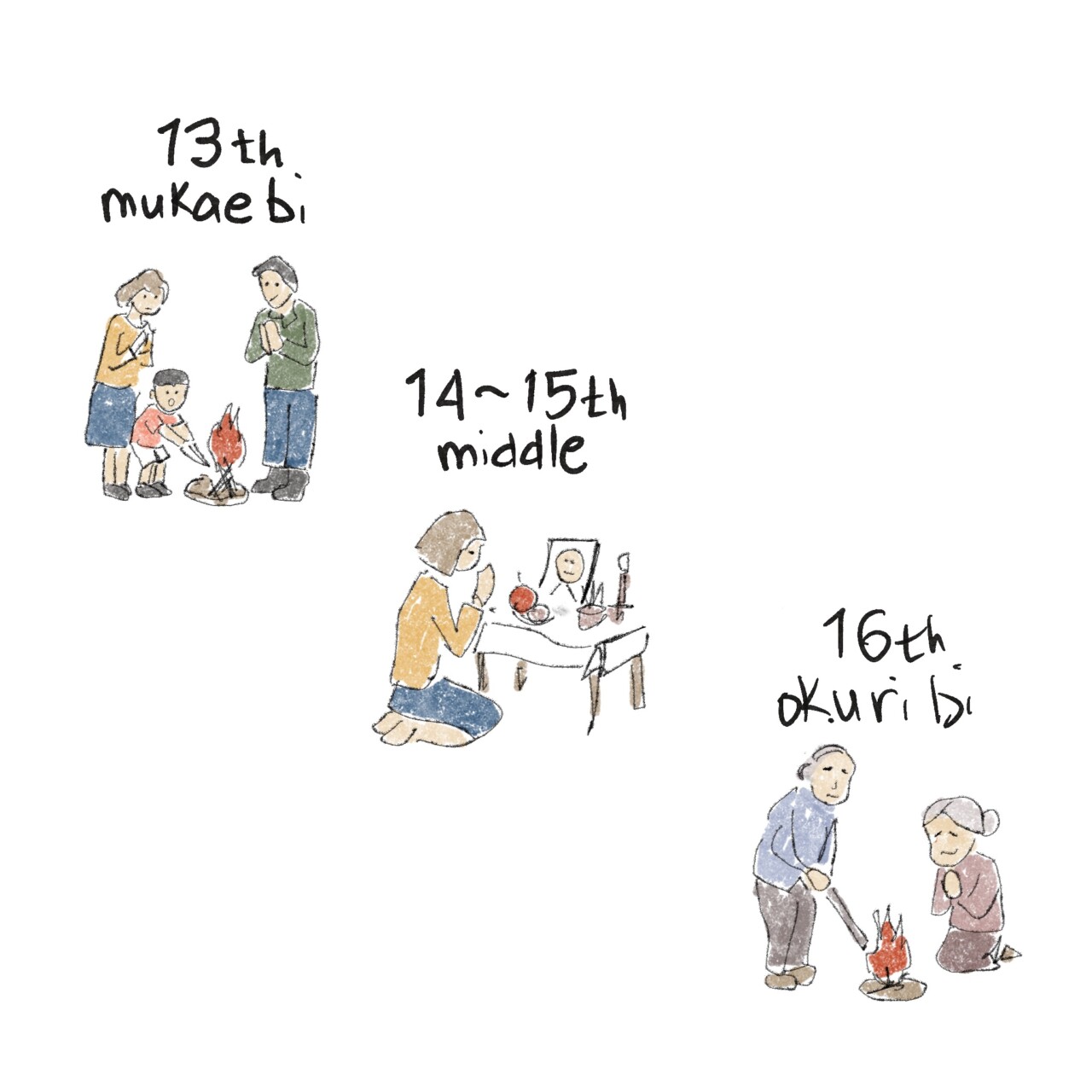
And if you ever ask anyone which they follow, keep in mind they’re called: Shin-bon (new obon) referring to the July dates. And kyū-bon (old obon) for August. Sometimes also called “tsuki okure bon” (one month late bon). Old obon (August) seems to be practiced more throughout Japan, especially in the rural areas. Maybe because in July people are still busy farming. Plus in August you have summer vacation from school and Obon is a time when people like to travel to grandma and grandpa’s house, so a good time for the grandchildren to meet the ancestors and hang out. As well as get to eat lots of yummy sweets and participate in other obon festivities, like dancing, fireworks, summer festivals, and floating lanterns down the river. Etc.
So, since I’m the only one taking care of Ojii-chan’s butsudan /family altar, and my ex-husband admitted he didn’t do anything special the past six years, I’m sticking to the easy to remember: August 13th to the 16th. Old obon. That’s also the one my mother-in-law and her mother observed. But I have to get my study on. So that’s why I’ve called you all here today. Let me tell you what I’ve learned.
First, I found a fascinating tradition called kamabuta tsuitachi (釜蓋朔日)– “the first day of the opening of the cauldron lid”. Or: “Okama no kuchi ake” = “the opening of the mouth of the cauldron.”
This one seems to be found mostly in the Kanto region, specifically the Tochigi and Nasu areas. It happens on the first day of July if you’re doing New Bon and August first if you’re observing the Old Bon calendar.
So what is it? Well, all those dead spirits and ghosts don’t just magically show up at house on the 13th of the month. No. They must be released from, um, hell or the Other Side, because it takes about thirteen days to get back here among the living. On the first of the month, Enma Daiō, whom you’ll remember is the king of hell, opens the lid of the cauldron or divider between the living and the dead, and allows everyone their brief journey home.
Some wild things about this lore.
One: Variations, of course, but on the first, some people used to go out into the eggplant or taro fields, press their ears against the ground, and listen. Because if you listened hard enough, it was believed you could hear the actual lid removal AND the screams and shouts (I’m assuming of joy) of the dead.
Two: While that’s going on, the living are making what are called kama no futa manju or tansan manju. These are sweet soda-leavened buns filled with red bean paste. They are placed on bamboo leaves and put on the altar to help keep your dead relative’s energy up for their nearly two week-long trek home. It was even written than some people prepared exactly thirteen buns, one for each day of the trip. Of course, you and your family are allowed to eat them after they’ve set out for a short time.
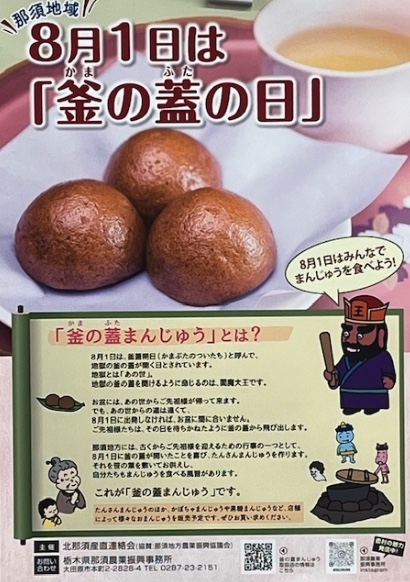
What I loved about this tradition is that I didn’t understand why they had to be made with tansan, baking soda. But I did find one place that alluded to all the spirits of the dead popping out of the cauldron all excited and feisty-like. So while I found no real source for this, it’s hard not to notice the image of the buns swelling as they rise in the steamer, and the ancestors themselves springing from from a hot cauldron. If that wasn’t intentional, all I’m saying, is missed metaphor opportunity. That’s all.
Can I just add here, too, that I love that the default is that all our dead relatives are in hell. Because, I mean, theoretically, yes, okay, I get it. It’s hard to live a perfect life. Somewhere along the line you’re going to lose your temper, lie, or partake in “insincere speech”. The rules are strict. Hop back to episodes 21 and 22 to learn all about the Great Screaming Uninterrupted Pain of Buddhist hells and how remarkably easy it is to get into them. It’s fun.
Anyway, I just love how matter-of-fact it is that the tradition is to put your ear to the ground and listen to the sounds of hell. There’s no keen your ears to the heavens for enchanting music and song; or take in the subtle sweet fragrance of incense and flowers. Nope.
So here’s what we know. The dead are released from basically the first of July or August until the sixteenth of the same month and they travel for thirteen days before they find you. But how do they find you? Because they can get lost. My mother-in-law told me about this a lot. And I’m not sure how big a belief it is in any other households, but it certainly was important in this one.
My mother-in-law loved to relay stories of spirits losing their way home and how dangerous that was. Not all dead people were good people. She almost seemed paranoid, like except for close relatives, all spirits were bad and wanted to wreck your life in one way or another. I’m not exaggerating when I say a good portion of her every day was protecting herself from unseen forces. So whatever happens, you don’t want some other wandering soul to take up residence in your house even if it is for only a couple days.
Now let me tell you what made me remember her stories and warnings, because I had completely forgot about them until something happened. Keep in mind that this old house that I just discovered is roughly forty-years old, is normally pretty chill. I’ve lived here six months and enjoy it, despite the clutter and swarms of mosquitos and all that. So, theoretically it’s considered obon season now, right? For those who observe July anyway. But I wasn’t really thinking of that at all when something began to feel off. First there were noises that woke me in the middle of the night and kept me awake. For about a week it was like someone in the room was crinkling paper. But then it would stop. But ONE night it was so annoyingly close by and didn’t stop that I went to sleep in the living room.
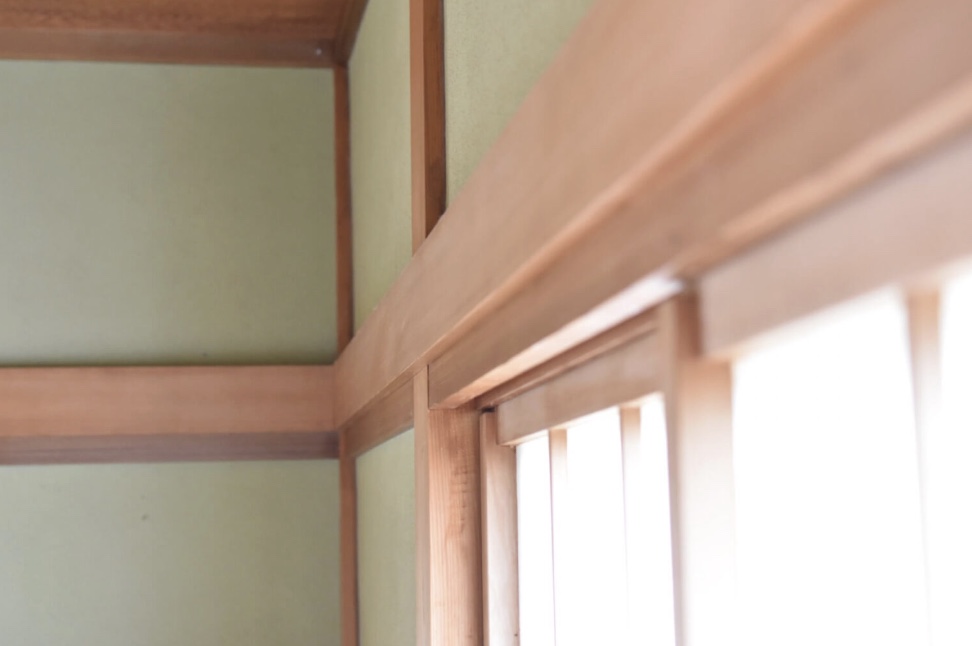
Side note: Your Japanese house architecture trivia for the day. There is a thing in old Japanese homes called a nageshi. It’s a long, horizontal piece of wood just above the sliding doors, about head height, and it runs all the way around the room. The exciting thing about this nageshi is that it’s actually positioned in a way that creates a gap between the wood and the wall. But it’s sealed at the bottom by another strip of wood. Think of it as a wonderful deep channel running all around the room that collects decades of dust and god knows what else. I just learned when looking up the name for the thing, they have special attachments on Japanese vacuum cleaners to get down in there. Good thing to know. So a deep rut, perfectly concealed unless you’re on a chair with a flashlight looking down. Which I’m not doing at two am. No freaking way.
The strange sounds were coming from the nageshi in my bedroom. So I’m not saying some random ghost got caught in there or was farting around trying to scare me. It’s more like some sort of vermin. Everyone, close your ears. Take those earbuds out and count to ten. Okay, the real horror. What do I think was in the nageshi? Something like a cockroach or mouse? Or a mouse eating a cockroach. A cockroach eating a mouse? Two cockroaches eating a mouse. I don’t know. Any horrible combination. But it just set the mood. And it also completely disappeared after that last really loud night. Knock on wood. But don’t knock on the nageshi wood. Lord knows what’s in there.
So I was feeling funky. But the next night, I stayed awake and no weird crunching noises. I slept like a baby. Now. Keep in mind, I live alone, no pets, no one has been to visit in weeks, no windows are even open. So when I woke up in a really good mood mind you, I walked out of the bedroom to find the neatly stacked pile of previously non-leaning flat zabuton pillows all knocked down. It was almost as if something or someone had come from upstairs and kicked them over.
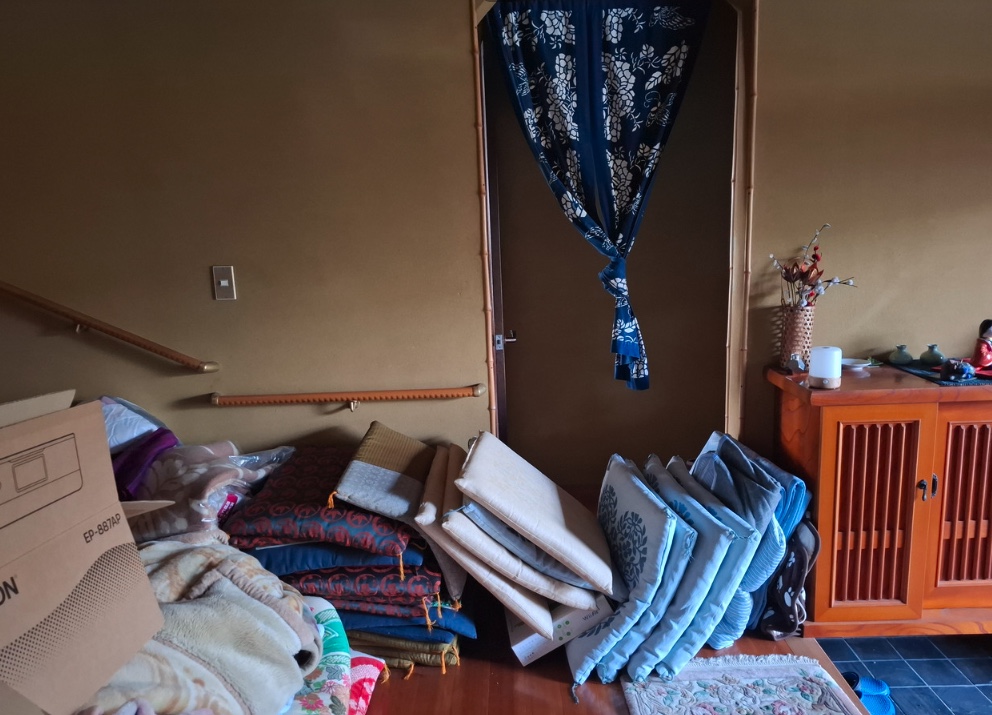
Again, I’m not saying woo woo paranormal, ghosts. But those flat cushions have been stacked for six months with no movement. Not even a lean. No earthquakes this way either. My Japanese friends are delightful in that they are leaning (ha) toward what I know my mother-in-law would have said. Spirits! Lost spirits! Maybe someone is wandering through trying to find their home. To whom I say, keep wandering little soul. Keep passing right on by.
Cue: lots of sage and things seem to be chill again. But the whole thing did get me interested in the proper way to call or invite your *own* ancestors home.
So first things first, before the 13th you need to clean the family altar. Dust it, polish candle holders and incense burners, what have you. Put fresh flowers in the vases. You should also go tidy up the family grave. Cleaning, sweeping, pouring water over the stone, wiping it down, leaving fresh flowers there, some unopened snacks or tea or sake. And also, lighting some incense and offering prayers. Just make everything nice and cozy for grandpa.
A note on Japanese graves. They aren’t the grassy plots and green rolling hills we have in North America. Think not a lot of space, granite or polished gray stones set side by side, a tall upright stone monument carved with the family name, some holders for flowers and incense, a shallow basin for water. Why I bring this up is because I think about 100% of people are cremated here, so everyone’s urns are placed beneath the monument inside a chamber that is normally sealed. And since space is an issue in Japan and the cost of just one of these grave stones is extraordinary, you can contain generations of family members all right there. So in effect you don’t have to go cemetery hopping to visit and care for every dead relative. If you’re lucky, they’re all in one place.
You want to hear a dark romantic line that used to be big back in the day. Not sure about now. But if a guy was serious about his partner he would ask something like: Will you accompany me to my family’s grave after you die? Meaning basically, take my last name and let’s have our urns side by side in that little dark chamber. For a while that was the pinnacle of romance. And you thought: Will you marry me? was romantic.
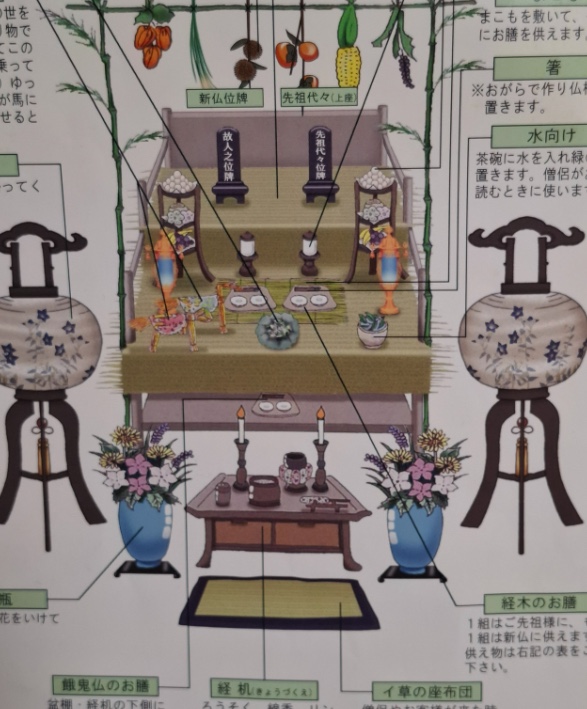
Back to altars. You’ve cleaned the altar, and now you get to decorate it. Again, so many different traditions and customs, but in general, you can put out a small temporary table called a bon dana or shōryō dana to handle all the extra offerings. A white cloth or straw mat is placed on the table, then on top of that there is a nice array of specialty items. For example, a lotus leaf (could be fake, that’s fine), that you can place offerings on. Small food or offering trays, lanterns, seasonal plants, flowers, and fresh fruits and vegetables. Candles and incense of course. The bowl bell which is ever present anyway.
One thing I often see is hōzuki (which I had growing at the old house, come to think of it). It’s a Japanese or Chinese lantern plant and is often strung across the altar because it looks like little lanterns. I wonder if I can go back and get some.
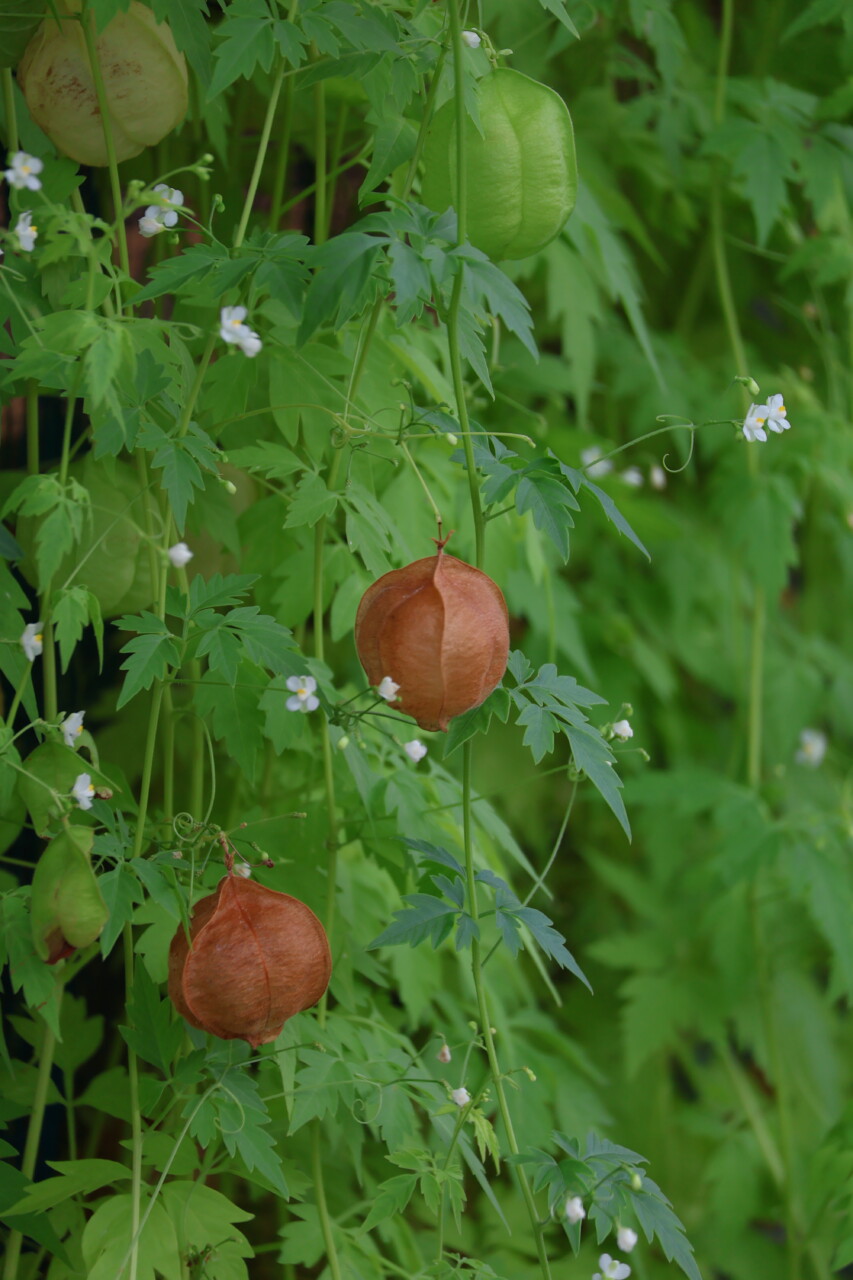
Anyway, most of this stuff to decorate the butsudan you can find in any supermarket or grocery store. Here you’ll always see the obon section from July through August 16th, at the entrance.
Another thing that is fun for everyone during obon season is ohagi, sticky rice balls covered in sweetened red bean paste. Offer to grandma, then eat yourself.
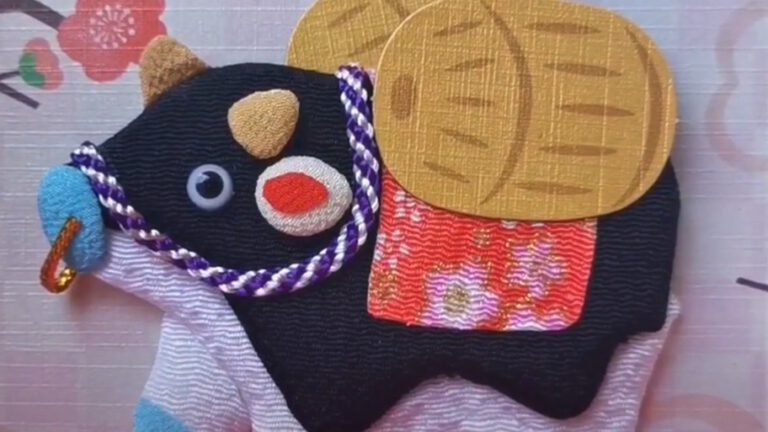
One of my favorite traditions is the cucumber horse and eggplant cow. This is fun. Hear me out. Again this is something not everyone does, but it’s more common that lying down with your ear to the ground on August first. These are called shōryō uma (spirit horse) and shōryō ushi (spirit cow). The spirit horse is made when you take a cucumber and insert four legs to make it stand up and look something like a horse. The legs can be ogara (hemp stalks), chopsticks, or toothpicks. Then to make the spirit cow you take an eggplant and do the same thing.
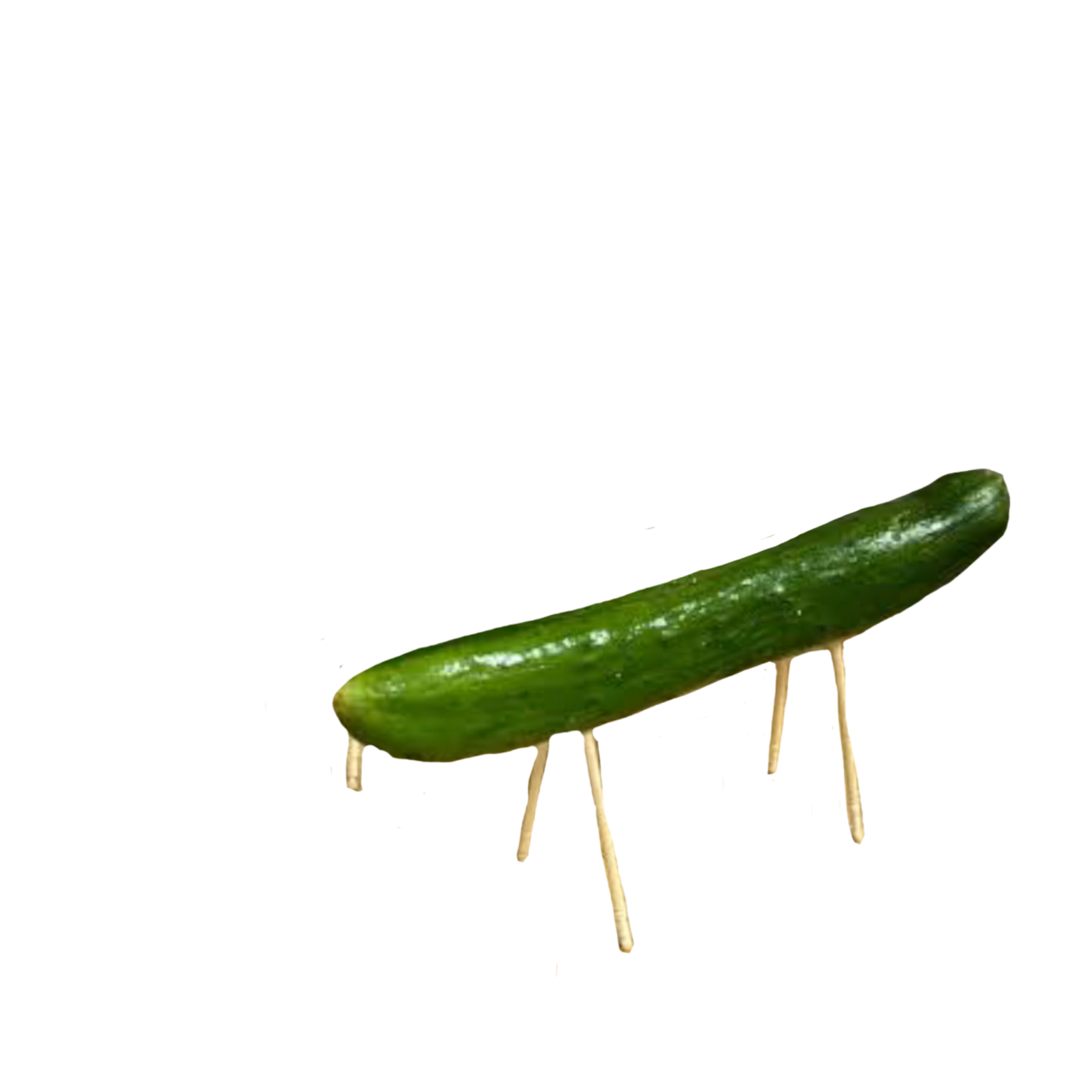
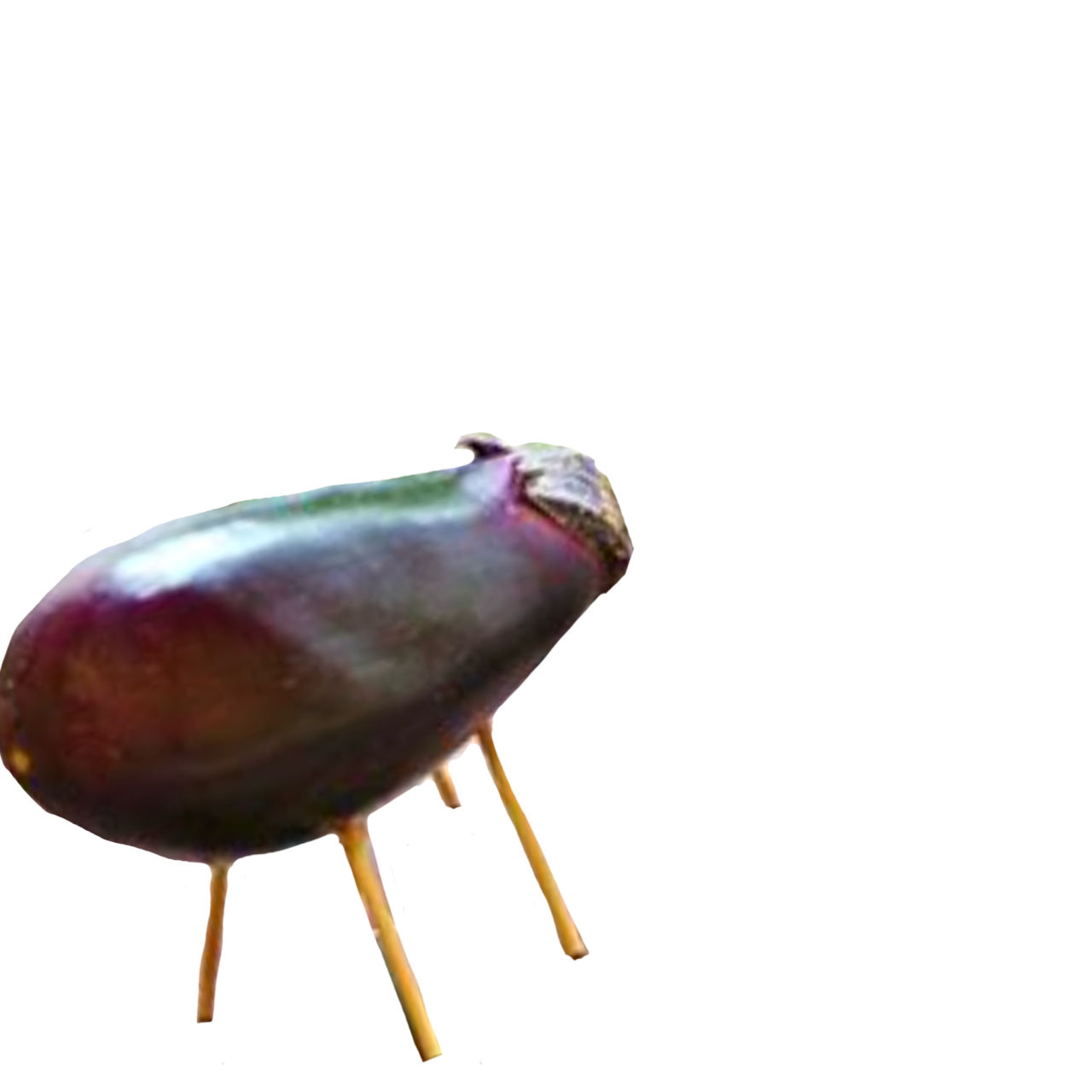
The thought being the dear departed hop on the faster cucumber horse so they can return home to be with the living as quickly as possible at the beginning of obon. When obon is over and they need to return, you’ll send them off on the eggplant cow. They can take their time going back, because you don’t want to rush them home and by home I mean “Hell”. And also, the cow can carry all the food, offerings, and gifts, so the spirits have something to do for the next year. Until they can visit again.
This is all symbolic by the way, you don’t actually have to like do anything. I’m not sure if that was understood or not. So just wanted to put it out there.
Lots of different regional variations here as well and like I said not everyone does this. I honestly don’t remember my mother-in-law’s father’s altar having these. As for placement, you can put them on that extra shelf or table on the 13th with the cucumber facing toward the altar, the eggplant away. But I don’t know if that matters too much.
Interestingly, Jōdoshū or Pure Land Buddhism describes these two spirit animals as transportation from and returning to the Pure Land, which is a kind of radiant paradise in the far west, presided over by Amida Buddha. So not hell at all. There’s a happier thought.
But even with that, the ancestors still are not guaranteed to find you. Another thing you could possibly do is make a mukaebi, or a welcoming fire. On the evening of the 13th, a small fire is lit in front of the house or gate, and prayers are made to make sure your dead relatives can properly find the right house. The fires are made in small fireproof earthenware dishes, or in this neck of the woods, it’s usually done in an old fry pan. You can buy (again in supermarkets) dried hemp stalks in little bundles and use them to make tiny bonfires. Or “bon” fires.
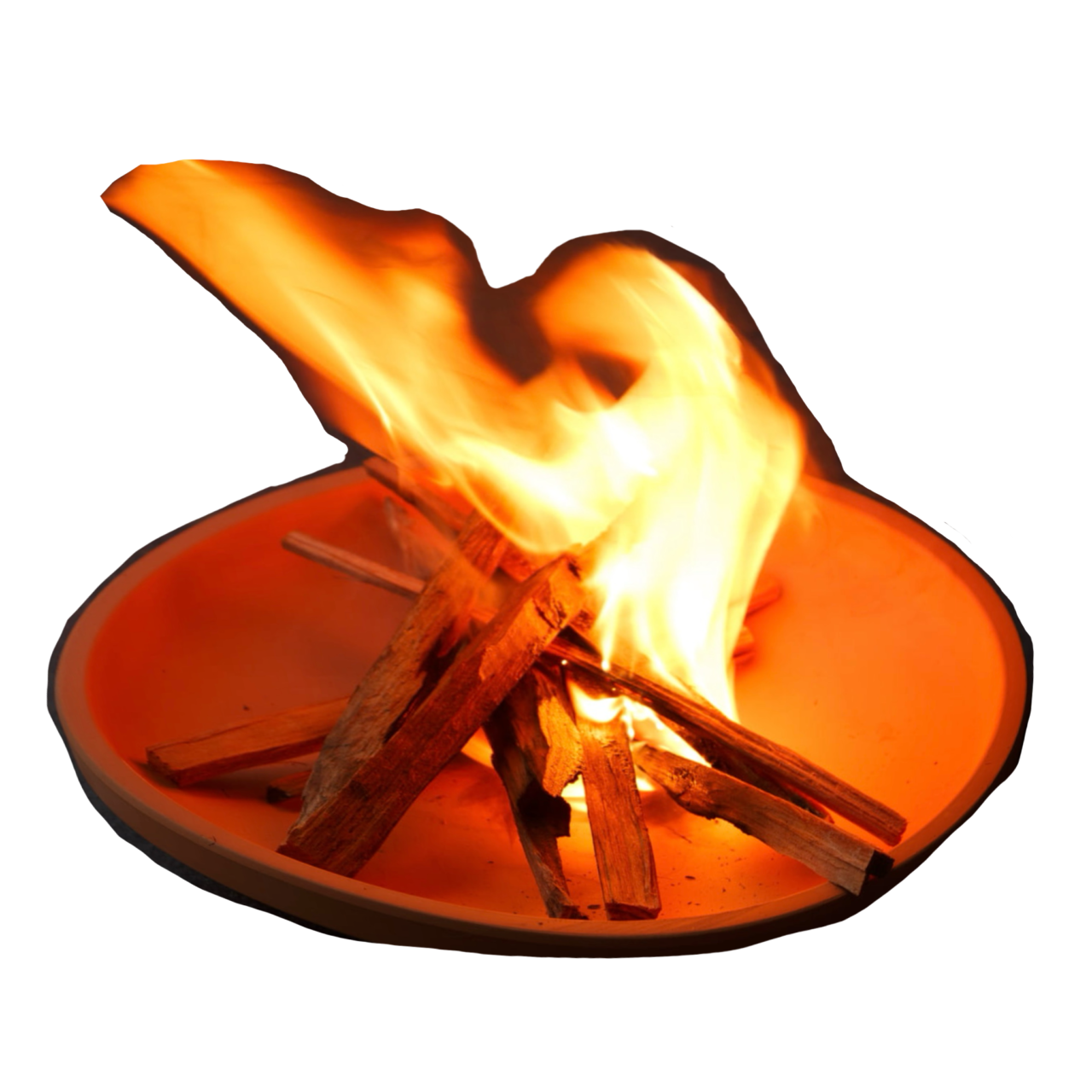
These are always fun to come across when you’re out walking on the evening of the 13th. And this year I’ll get to make my own!
If you live in an apartment or some place where it’s difficult to actually start a fire outside, you can use an electric lantern, battery-operated candle, or something else symbolic but no possibility of burning the place down.
So, at last, all the souls have returned to your house and the party can get started. Kidding. However, for the period of Obon — again this is area and family specific — but special meals are given, refreshed daily, prayers are offered. Lots of bell ringing, candle burning, and incense lit. Sometimes people call a monk to come and chant at the altar. Especially on special anniversary days, like the first obon, or the second obon of someone’s passing.
Another side note: During this obon season, I was told every year never to kill a bug, because it might be grandpa coming back in insect form. Which works wonderfully with dragonflies and ladybugs, what monster would kill them anyway? But the roach kind, sorry. Any relative who thinks it a good idea to come back as a giant cockroach is just asking for it. They’re going to find their way back into that cauldron quicker than you can say Get the boot!
After a pleasant couple of days, it’s now time to say goodbye. Either on the 15th or 16th you need to get the spirits on their eggplant cows and send them back. But this part of obon is actually beautiful and has so many fascinating traditions.
There are the household rituals, another fire is lit at dusk outside, this time called an okuribi or sending off fire. Prayers are offered again. Then you have community events like floating lanterns or boats with the deceased person’s name on them down rivers or in the ocean. This is called tōrō nagashi and you can ask around to see where one will be held near you. Keep in mind sometimes they’re done in the early morning.
Note: at least in my city you’re not allowed to leave these things in the water like they did back in the old days. It’s all nice and symbolic but then in the end you need to turn everything over to the city for proper disposal. Otherwise, you’re just littering and that’ll get you fined.
Different places have different customs but probably the most famous is the Gozan no Okuribi in Kyoto. On the night of the 16th, five giant bonfires are lit on five different mountains surrounding the city. There’s the daimonji, fires shaped like the character for big. The Myō/hyō kanji for wondrous dharma (Buddhist teachings), funagata, fires in the shape of a boat, hidari daimonji, another giant character for big, and finally, toriigata, fires lit to resemble a shrine gate. So if you’re in Kyoto, check that out.
And that’s roughly how it goes, from guiding your dearly departed loved ones from the Other Side to this world of the living, entertaining them for a while, and then sending them safely home on an eggplant cow packed with gifts and prayers.
Thank you for listening, Ojii-chan was super nice and always loved having friends and family come visit. I’ll tell him you said hi. If anyone iffy shows up they’re getting a shoe or the sage. Wish me luck.
I’ll talk to you again in two weeks, bye bye