*humming*
You’re just minding your own business, taking a stroll through the woods, humming a little tune to scare away the snakes and the monkeys and the bears. Because that always works.
When you hear something that sounds like gii gii. Is that a straining rope out here in the middle of nowhere?
It’s coming from above you. You look up and bang! Lights out. What was it? A rock? A well bucket? A giant severed head? Why not any one of those three?
Let’s learn more about the tsurube otoshi on today’s episode.
Hey hey. This is Thersa Matsuura and you’re listening to Uncanny Japan. The place where I talk about all the more obscure parts of Japanese culture. Be it weird creatures, interesting superstitions, or creepy tales, or I don’t know, bugs. I’ve been talking about bugs a lot lately, haven’t I? I know you’re on the edge of your seats. Yes, more bug banter today. Just a little. Not cicadas. Not cockroaches. But Suzumushi. Bell Crickets.
Listen to that. Aren’t they nice? Every summer I buy a couple suzumushi and raise them. Remember how all the types of cicada were the sound of summer? Well, as you already know, crickets are the sound of autumn.
But did you know, in old Japan there was something called mushi-kiki, listening to insects. So rather than people just thinking of bugs being an annoying noise in the background, they actively went out at night and listened to them. A grassy slope, a riverbank, a temple courtyard.
And this is neat, there was famous place called Dōkan Mountain where all the literary types would gather to sit, sip sake, gaze at the moon, and listen to all the different variety of singing insects. Just be. Enjoy. Feed their literary minds and hearts.
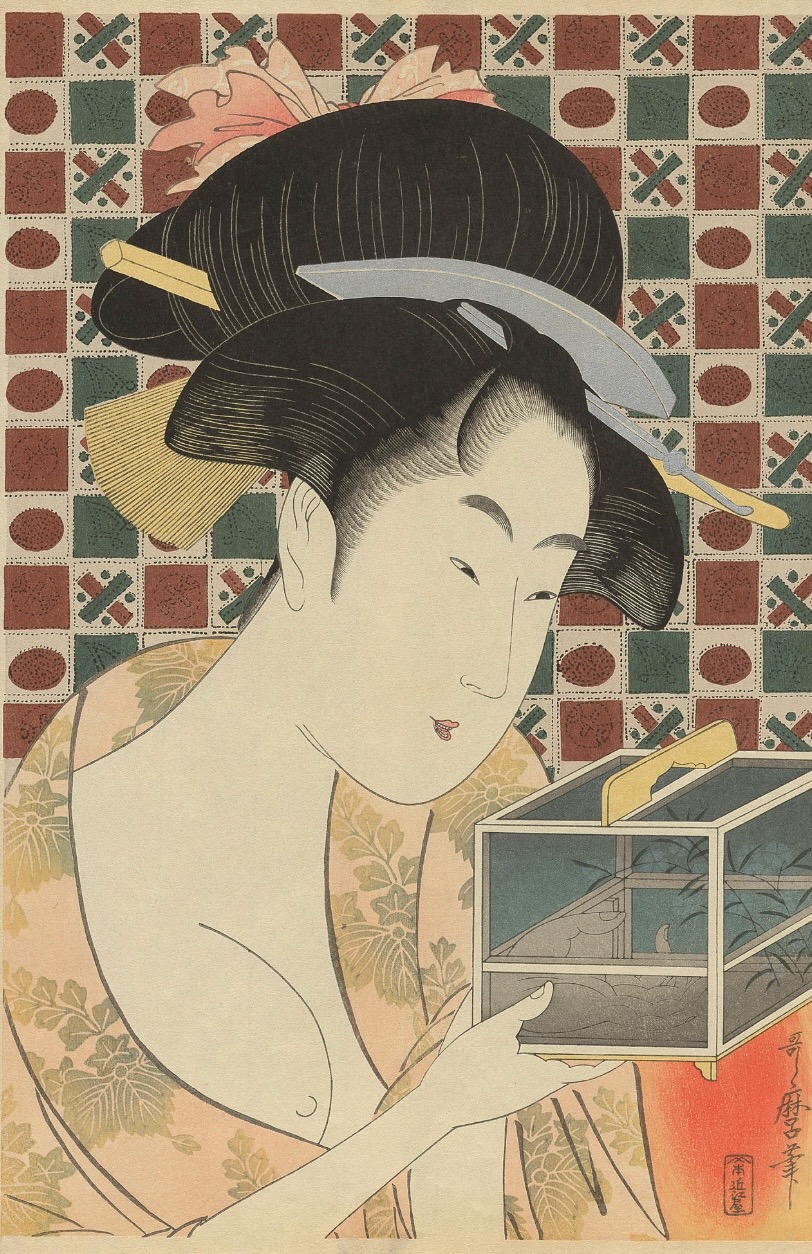
Another thing people did was to catch one or two and keep them in these fancy little cages called mushi kago. Then they’d set them around the house so their homes would be filled with the ethereal trills and songs. Remember this is before radio and TV. So totally makes sense.
Do you ever feel that people of old were just so much more in tune with the natural world, noticing and appreciating the change of seasons. Maybe the way the moon rose on a certain night, or the wind blew in colder, a different bird began to call. And now we all just have a screen up to our nose and don’t even notice the real-life rainbow right there in front of us? Or how the clouds look like a dragon blowing smoke. Yeah, I think so too. So I bought a box full of bugs.
Like I said, every year I get a couple males (they do the serenading) and a couple females (they do the listening, eating, and egg laying), and I deck out a nice cage for them with leaves and sticks and places to hide and chunks of eggplant and cucumber and we all have a really good time.
Except this year I’m in the new house and had the brilliant thought. If 5 bell crickets are delightful, then 25 will be five times better! Side note: My economics professor who did that lecture on the Law of Diminishing Returns would not be proud of me.
It was cricket bedlam trying to get them from the box to their new cage. Crawling up my arm, sticking to everything. It took awhile, but they all got moved in. And remember they’re nocturnal. So they sing all night long. I basically have to keep them in the same room where I sleep, so my dreams are all about sirens, people screaming, alarms. It’s funny though. I love the little guys. But I am a little concerned when the females start laying eggs. Another thing I didn’t consider was how many will hatch next year? I might need to start my own cricket business.
My other idea was to record them for the background to the show, only 15 crickets all chirring frantically at once is a little much. So I had to wait until they all fell asleep. All but one. This guy you hear now. Bless his little cricket heart. Trying to woo the ladies. They’re all in cucumber comas at the moment though. But “A” for effort little dude. You’re not quitter. Also, now you’re famous. You’re on the show. To mix it up, I recorded the different sounding crickets outside my window as well. So it’s an autumnal melody.
Speaking of autumnal melodies. Yes. Listening to and enjoying fall insects is an old Japanese tradition and was practiced for centuries. And hearing them is one of the first signs that fall has arrived. The cicadas begin to fade and from the tall grass comes the clear high notes of the suzumushi, bell crickets.
Which is all very lovely. Except autumn evenings have another thing going for them. They get dark very, very quickly compared to summer’s long days.
And there is even a proverb talking about it. That sound you hear is me patting myself on the back for the clever seque.
The seasonal phrase goes like this:
Aki no hi wa tsurube otoshi.
An autumn day (or autumn sun) falls like a well bucket.
It means that in autumn the sun seems to sink as quickly as a well bucket dropping down a well. So ”aki no hi wa tsurube otoshi” refers to how early night falls in autumn. Unlike summer when days are long and even twilight lasts forever, in the fall once the sun starts to set, it becomes completely dark almost immediately.
Japanese dictionaries show that this phrase was used in 1862 in a kabuki play called Kansen Chōaku Nozoki Karakuri. In act six if you’re keeping notes. The line went something like:
“Since the evening bell has already sounded, and autumn days fall like a well bucket, it will be dark before long. I think I shall take my leave for today.”
So there you have the phrase tsurube otoshi in its original meaning.
Cue: yōkai. Maybe you’ve heard of it? A giant hungry head that drops out of trees? Well, yes, sort of. There’s actually more.
First, it seems there’s actually no real proof that the autumn proverb inspired the yōkai or vice versa, but my sneaking suspicion is there is a connection. Those old artists who collected and depicted various yōkai (especially Toriyama Sekien) had wonderful senses of humor and were never ones to shy away from a good pun. I can see it happening. But that might just be me.
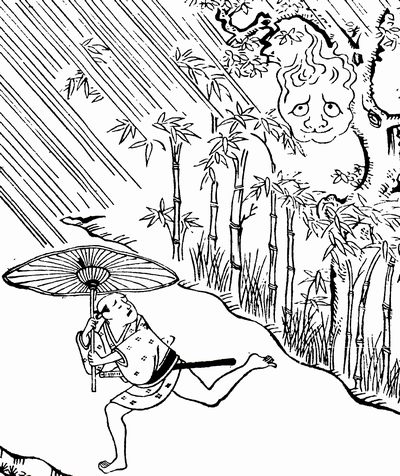
So this Tsurube Otoshi is one of my most recent beloved yōkai. I even wrote a story about one for my upcoming book, Dark Tales from Japan. It’s funny. It’s horrible. I can’t wait for you to read it. But before I wrote the story, I had to read up on the strange phenomenon. They’re much more complicated that I imagined.
The first thing I found was they aren’t just one thing. There are all sorts of variations. Where do we start? Well, the basic premise of a tsurube otoshi is you’re out walking in some remote area under a tall tree — they are particularly fond of coniferous trees — and wham! Something falls from above.
It descends suddenly and then stops just before hitting you…or it just goes ahead and hits you. At which point your might just die and get eaten. End of story.
But what falls precisely changes from region to region, story to story. In one, you hear about an actual well bucket falling. Very on brand. It’s what you’d expect. A little weird out here in the middle of nowhere, but okay. Or maybe the thing that falls is a large rock, dropped or pushed from the tree top.
There are also the stories of a bunch of normal-sized to smaller heads plummeting all around you, or I suppose the worst: a giant severed head descends. This can be a human head (often red) or the head of a tengu or an oni.
Oh, did I mention they’re hungry? Yes. And you’re their meal. Or whatever they happen to catch. It could be an animal. But it’s probably you.
There are versions where they just outright fall and smash the person walking under the tree, or trap them and pull them up into the tree, or use something shiny on the ground to attract their victim. The person goes to pick it up thinking it’s a coin, the well bucket falls, they get pulled inside and hoisted up into the tree to be dinner.
There are also tales of tsurube oroshi. The difference in the names being otoshi or otosu means to drop something from above. Oroshi or orosu means to let something down. A little less dramatic maybe, but not really. Same end result usually.
Probably the most well-known story of a tsurube oroshi appeared in the 1925 folklore collection: KuchiTanba Kōhishū, gathered in southern Tanba, which is now the Kameoka area of Kyoto.
At Hōki in Sogabe Village a tsurube oroshi was said to live in a kaya tree. It would descend suddenly, laugh loudly and say:
Yagyō sunda ka? Tsurube oroso ka? gii gii.
“Finished your night work? Shall I lower the well bucket! Creak creak!”
Then it would rise back up into the tree. But the story doesn’t say clearly WHAT it was that fell from the tree. I guess we’re assuming it’s a head. Rocks don’t normally talk. Nor do buckets.
Then there is another account from the same village. This one happened under an old pine that stood all by its lonesome in a field. It’s name was ipponmatsu, the lone pine. This story went something like:
In the fields of Tera stood an old pine called the ipponmatsu. From long ago, people said that toward evening a head would descend from it, haul up passersby, and eat them. After eating someone, perhaps because it was full, it would not descend again for a couple days. After awhile, however, it would catch someone again.
There are more recent accounts as well. Well, ha ha. In Mie Prefecture, in 1981, there was a rumor going around that a tsurube otoshi lurked beneath or within a large tree. Which if someone bent over to pick up a shiny object laying on the ground, they were pulled upward into the tree. Another Mie story said that after sunset from a great tree on a temple path, a bucket would descend and an impossibly thin, threadlike rope would wrap around its victim and haul them up.
Then in 1992 in Ishikawa a tsurube otoshi came from the sky itself inside a bamboo grove near an abandoned house. If or when a person touched it they got stuck and were pulled upward into the heavens.
Now let’s go back in time again to talk about another variation of the tsurube otoshi. To 1686 in Yamaoaka Genrin’s Kokon Hyakumonogatari Hyōban there is a story called Nishi no oka’s Tsurube Oroshi. Here it’s not a head or bucket but a ball of fire.
Speaking of fire, later in 1776, Toriyama Sekien created his version that he named the tsurube-bi. Bi meaning fire. And again it was a ball of fire hanging from a tree. I’m not sure how much eating was involved there. This was in Toriyama Sekien’s first book where he just had his images and names, but no real stories associated with them. That came in his following books.
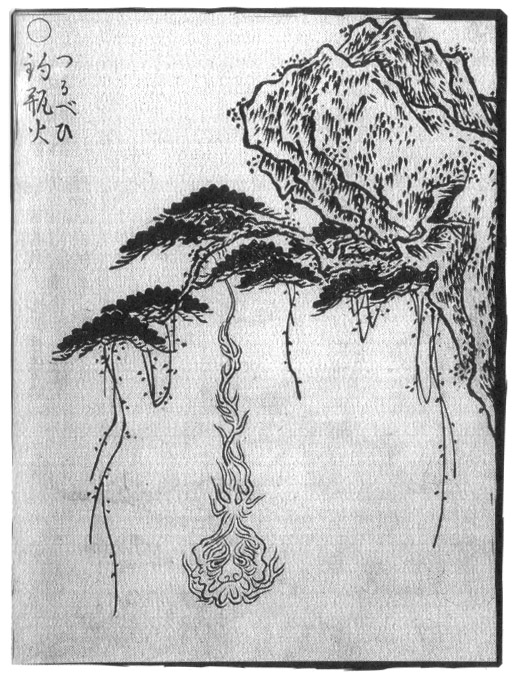
So, yes, the tsurube-bi seems to be more a dangly pale blue ball of fire, bobbing up and down mysteriously in these tales. And if you look closely you can see the face of people or animals in the flames. These very well could have been the origin of the later giant severed hungry head. You can just see the escalation in the telling from small mysterious ball of fire to ENORMOUS SEVERED HEAD that wants to eat you alive.
So there you go. I think that covers it. The tsurube otoshi, tsurube oroshi, and tsurube bi.
So remember as the weather cools and you’re out at dusk walking under the tall pines, you can use your new phrase to impress your friends: aki no hi wa tsurube otoshi. Just remember to keep looking up and be ready to dart sideways if you hear gii gii or someone asking about your nightwork.
If you want to go darker and more obscure to impress your friends, you can quote an even older expression: aki no hi nata otoshi. The autumn sun falls like a hatchet.
Now there’s a yōkai just waiting to be born.
Thank you all for listening and I’ll talk to you again in two weeks.