Beginning:
What do you think about white snakes? How about human-headed snake deities? Did you know that both of those are connected with Benzaiten, the Buddhist patron goddess of literature, music, wealth and femininity? Well, they are. And let me tell you all about it on today’s show.
Intro:
Hey hey, this is Thersa Matsuura and you’re listening to Uncanny Japan. The place where I talk about all the more obscure parts of Japanese culture. Be it weird creatures, interesting superstitions, creepy tales or, you know, grandpa-headed snake gods, like today!
I’ve actually been working on four different episodes at once. The first one is super oof-dark, so I keep having to stop and pick up something lighter. I start on it again for a while, then noped back out into an entirely different topic, before returning to it once more. The problem is it’s so fascinating. I’ll get it done, but maybe a little later in the year, you know when everything is bright and cheery in the world again. Ha ha.
Reminder that by becoming a patron, for most tiers, you can get ad-free versions of the show and extra content over on the Uncanny Japan Patreon site.
Also, I never thought I’d say this: but don’t buy my The Carp-Faced Boy short story horror-collection. I haven’t received royalties from the publisher in many years. But I do now have the rights to it, so I’m going to re-read the stories, add some more, and re-release it also later in the year — you know, when things are bright and cheery again. You can, however, buy the audio book — which is me reading my stories. I own those rights.
As for today’s background vibes,
Pod:
This whole episode came about because of a housewarming gift, which I can confidently say is the best housewarming gift I’ve ever received. Thank you Etienne!. It’s a statue — about as big as a breadbox — of a white snake all curled up around a bag stuffed with something that’s been wedged between two tree stumps. The snake’s head is resting on the open top of the bag and you can see it’s filled with coins. So the bag is stuffed with money.
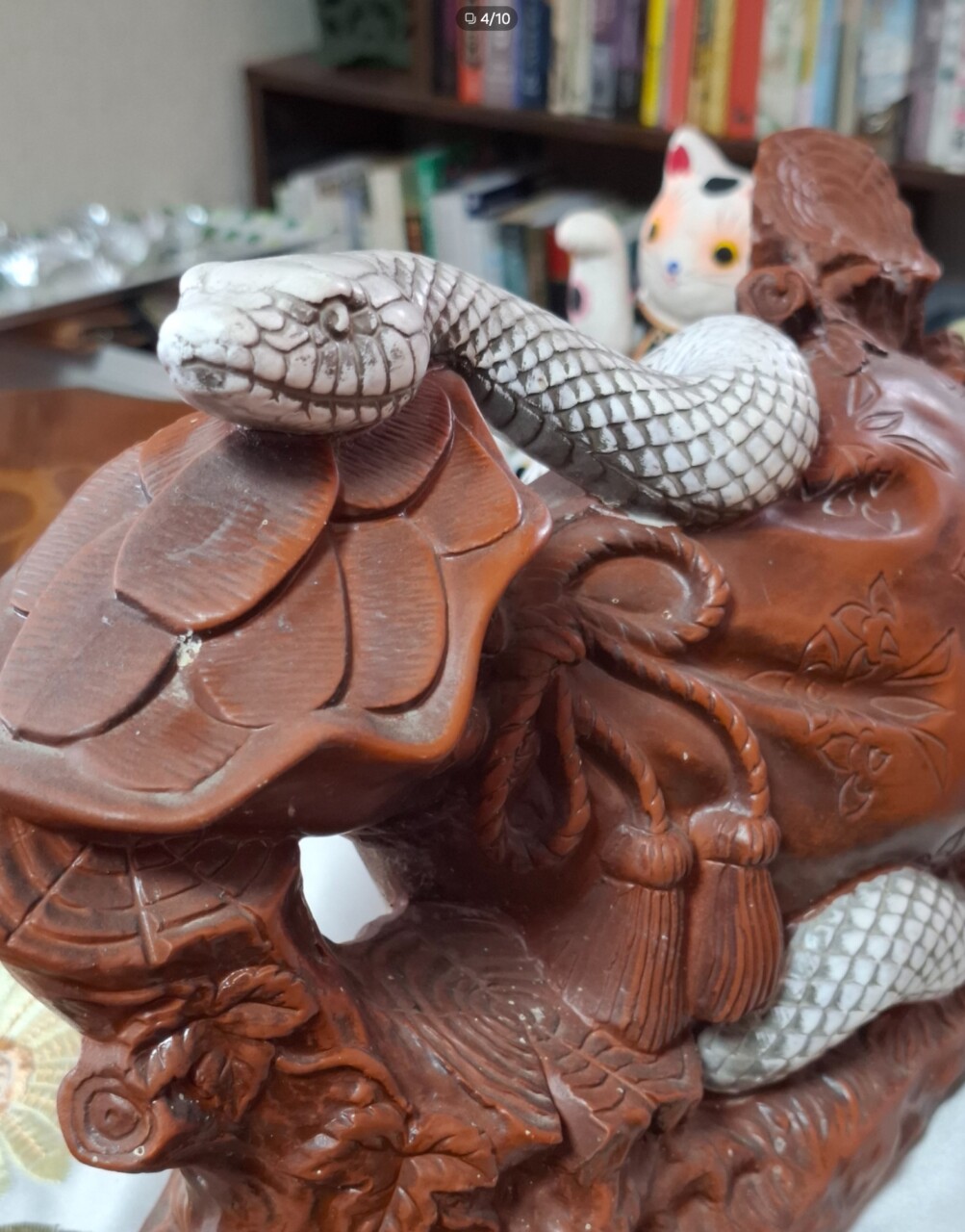
Somewhere in the recesses of my brain, I knew that white snakes and money had some connection, but I couldn’t remember where that idea came from or why. So I decided to do some research.
Let’s talk about white snakes. But before we talk about them, we need to back up and talk about the female Buddhist goddess Benzaiten.
Benzaiten — also called Benten — has made quite the journey. In India, she began as the Hindu goddess Saraswati who was in charge of rivers, knowledge, and speech. She was absorbed into Chinese Buddhism, kept moving East, and then sometime between the 6th and 8th centuries, made her way to Japan’s shores. While here she found herself not only beloved by the Buddhists, but also became a Shinto kami, as well.
And beautiful overachiever that she is, Benten-sama procured herself a seat on the Takarabune, otherwise known as the Treasure Ship. She is the sole female member of the Seven Lucky Gods. She’s the one playing or holding the biwa, lute. So I think it’s about time we talked about her.
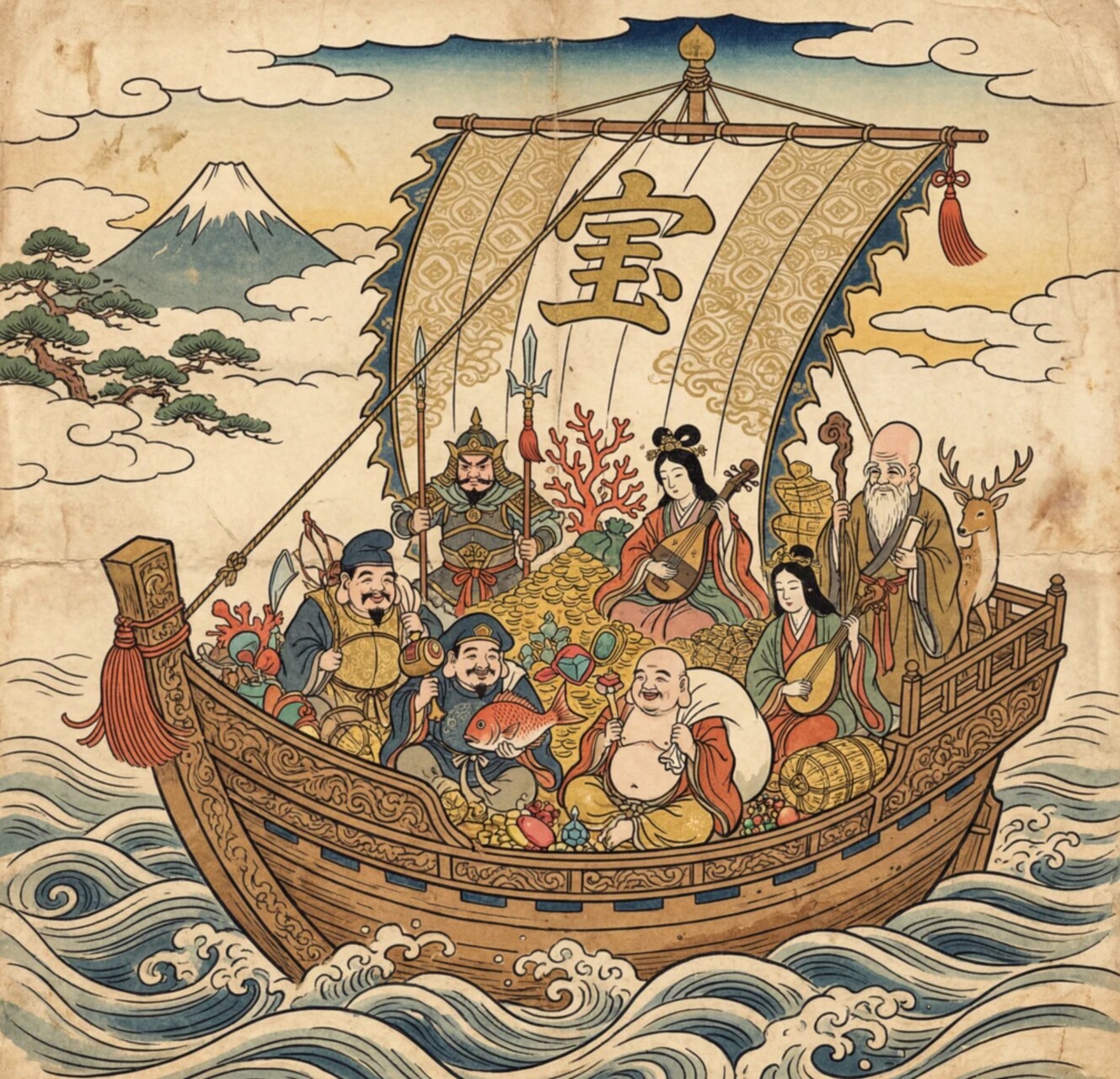
Benzaiten is truly a marvel and while so multi-faceted you might find yourself overwhelmed with all she can do, you wouldn’t be wrong to think of her as the goddess who oversees everything that flows: Water, words, music, inspiration, creativity, even money.
That last thing is reflected in a subtle name change. The older writing of her name Benzaiten had that middle kanji meaning something more like eloquence. The goddess of eloquence. The eloquent diva. Then keeping the same pronunciation that middle character started being written with the kanji “zai” (meaning: wealth), Goddess of Wealth.
There are shrines dedicated to her all over Japan, some very big and important, some small and nothing more than a stone monument in the ground. I did a quick search in just my area and found over a dozen. There are, however, three great Benzaiten shrines.
1. Enoshima
2. Chikubushima (Lake Biwa)
3. Itsukushima (Miyajima)
Notice all those have the word shima in them, island. Because all of them are surrounded by water. Since she is associated with water, many if not most of the shrines will be found near ponds or lakes and sometimes built on little islands in the middle of those ponds or lakes.
Remember I said she is often portrayed as holding the lute-like biwa? Well, she might also be holding a sword or many swords as she was a protector of the Buddhist law for awhile. Some artwork even has her with a wish-granting jewel.
Just so we can get this straight: She started out in as a Hindu goddess, was adopted into Buddhism, and then again into Shinto. Very interestingly, in Shinto she has an entirely different name: ichiki shima hime no mikoto. Here she is thought of as one of the three Munakata Goddesses, or one of the three daughters of the sun goddess Amaterasu.
Ichiki shima hime no mikoto is the goddess of the sea, navigation, beauty, and the performing arts. Again with the “things that flow” theme. How was she born you ask. Well let me tell you, because Shinto births rock.
Remember when Susanoo (wild and crazy god that he was) and how he went to visit his sister Amaterasu to say goodbye because he was being sent away for all his over the top grieving of his mother — who, poor thing, died by being burned alive as she was giving birth the fire god?
I told you Shinto mythological births rock.
Well, he did. And when he went up to Takamagahara to see his sister, Amaterasu, the mountains and rivers and land began to tremble and rage. So Amaterasu was a little worried he was coming to attack her — a pretty solid worry given his character. So she dressed in armor and met him with a sword. One thing led to another and it was decided that they should have a kind of contest. The non bloody kind.
So long story short, Amaterasu takes his sword, breaks it into pieces, chews them, spits them out and three goddesses are born. One being Ichiki shimahime no mikoto.
And just so you know, Susanoo takes the magatama jewels from his sister, chews THEM up and spits THEM out and from there five male deities are born.
Susanoo in Susanoo fashion, claims he won the challenge.
Anyway, that’s how it’s said she was born per Shinto mythology.
Do you know that floating torii gate in Hiroshima that’s a UNESCO world heritage site and you see photos of everywhere? Well the shrine associated with that torii gate is the Itsukushima Shrine and dedicated to her and her two sisters. And you can see the water connection here, too.
Under her Benzaiten persona, she was so popular that a Japanese buddhist monk named Kōkei wrote a history of the shrines and temples of Enoshima, Eno Island, back in 1047 and stated that she’s actually the third daughter of the dragon king of Munetsuchi. Munetsuchi is the lake that lays at the center of the world according to an ancient Buddhist cosmological thought. This lake is the source of all water. So with this mythology she is the third daughter of a dragon king
But later, the legend goes that there was another dragon, a five-headed one, who was quite evil and terrorized the place: starting landslides, causing floods, whipping up storms, and basically making life miserable for everyone living nearby. Then in 552, the clouds gathered, the earth shook and a beautiful heavenly maiden descended from above. When the clouds cleared a new island had appeared. That was Enoshima.
The five-headed dragon saw the heavenly maiden and fell instantly in love. He asked her to marry him but she refused. Saying something like, and I paraphrase here, this isn’t because you’re a dragon. That part is okay. But you have really caused a lot of harm here, making peoples’ lives hell, so I don’t think you’re marrying material.
The dragon was so in love, that he then repented and promised to start protecting the people instead killing them. Which he did. The heavenly maiden believed that he had really changed and the two married. That heavenly maiden was enshrined on Enoshima as Benzaiten.
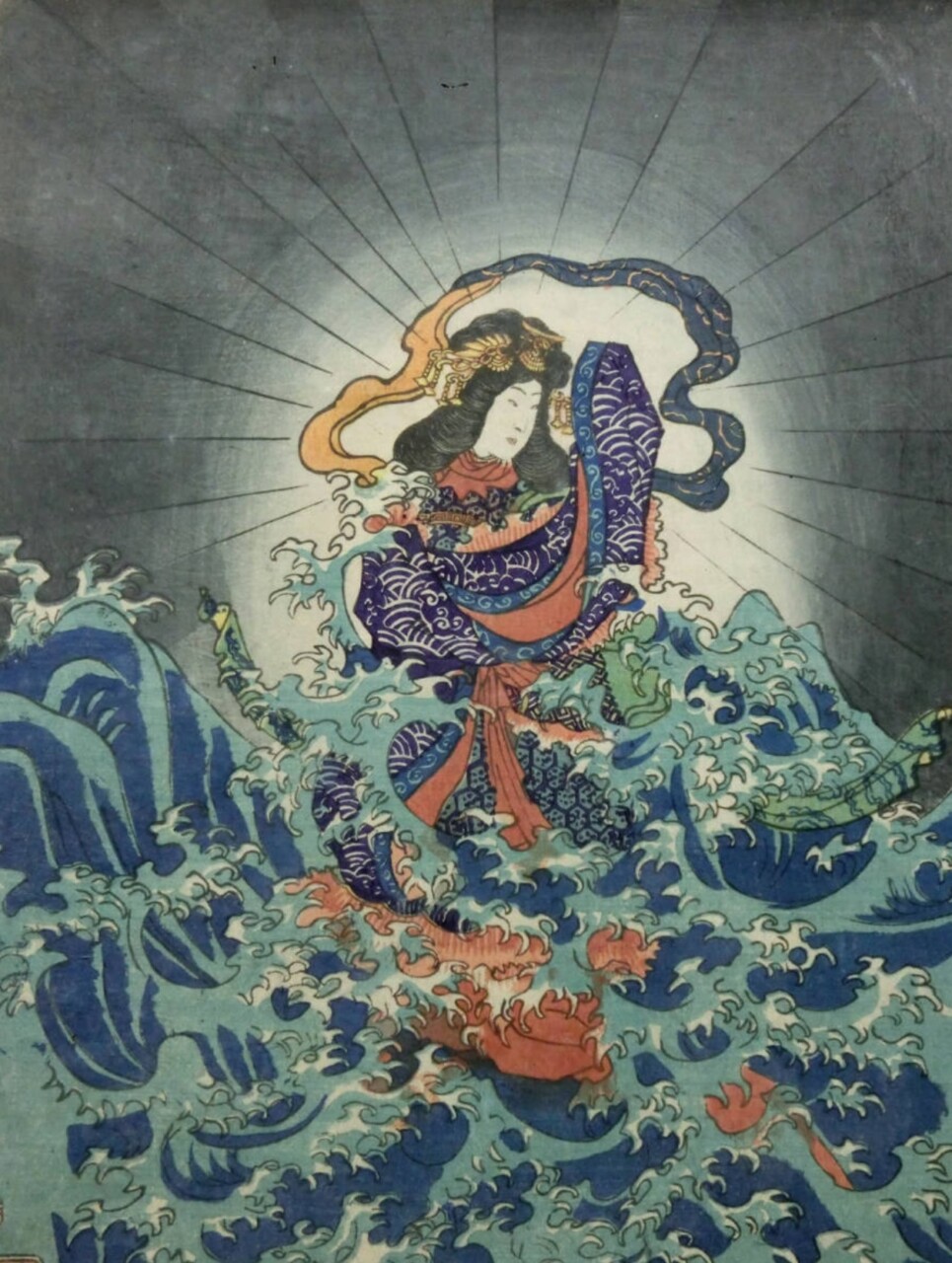
Here we finally see the goddess Benten and the dragon/serpent/snake figure becoming associated with each other.
Let’s step into snakes for a moment. In many regions of Japan, snakes are believed to be kami no tsukai, meaning “messengers of the gods”. So killing a snake isn’t only bad luck, it might bring divine punishment.
Remember hebi tsuki, being possessed by a snake. So there’s that, too.
Basically the message is, let’s be kind to all the little creatures. Except Japanese cockroaches. Those things were forged in hell. I digress.
Some snake-y lore. If a snake visits you over and over again, it’s not random. It’s considered a divine visitation. In olden days, this would mean the little danger noodle needed to be enshrined and worshiped. This is how house snakes became household deities. So how does that happen?
Well, it didn’t involve building a little snake shrine in your garden from scratch or formally declaring your garden snake “a god”. But what was often done was to identify a shintai (object the spirit inhabits). This might be a stone or a tree — something associated with the snake. Maybe it likes to bask on a certain flat paving stone. There’s your shintai. Now you can treat it kindly. Acknowledge the kami spirit resides there and consider that maybe it’s protecting you. So you can in turn protect it by keeping it clean and tidy, well swept, perhaps. Maybe offer some eggs occasionally that the snake might show up and partake in.
There are actually snake shrines all over Japan and most likely they all started small like this. A strange event or repeated sightings. People started paying attention to that area, respecting it. Offerings began. And then over time it becomes a real shrine — or a hokora (small sub shrine) — the deity was eventually named, and other people would begin to visit to pay respects and give their offerings. And this just continued down through time.
Snakes in general, in Japan have long been associated with money and prosperity. Yeah, some people balk at snakes, but when your grain is being eaten by rats, a snake is a good thing to have around. By eating the varmints it is putting money in your pocket. You’ve got more grain to sell.
Even today, you can find people owning snake skin wallets or people who keeping a real snake skin IN their wallet as a way to coax more money their way. My father-in-law had one all folded up and slipped inside a pocket in his wallet. Also, white snakes — being rare — are even better and considered holy, super lucky, and bringing more prosperity.
Interestingly, these white snakes or shirohebi, appear in the wild often enough in Yamaguchi prefecture that they have their own White Snake Museum and festival. The belief is that because they are so revered and they’re treated kindly, that the population has just naturally increased.
Let’s connect Benzaiten and the white snake.
This association came about most likely due to a wonderfully bizarre thing called uga benzaiten.
Before there was uga benzaiten. There was ugajin. An ugajin is a mysterious deity that is depicted as a large snake coiled up with either a male or female head. If male, the head will be that of an old, white haired, bearded man. If female, just your average woman’s head on a snake body. It’s worshipped as a guardian of abundant harvests and plentiful fishing.
The name ugajin might have derived from ukanomi tama-no-kami from Japanese mythology. Or from ugaya, the Buddhist term meaning “the giving of wealth”. Originally ol’ ugajin was a folk deity representing the spirit of grain (so an agricultural god), and a fortune bringer.
Side note: there is actually the last name Ugajin in Japan. I’ve never met an Ugajin, but if I do I’m going to marry him. Or try. Or maybe just be friends.
Along the way, Tendai Buddhism incorporated the weird snake deity into its teachings and merged it with Benzaiten. By the Kamakura Era, there was a kind of cult of Uga Benzaiten and it became part of the esoteric practice. So suddenly there are all these uga Benzaiten statues and artwork that show Benzaiten with an ugajin not wrapped around her body or curled up beside her, but sitting on. top. of. her. head. Like a crown. Like a snake crown. Like a snake crown that has the head of a little old man. Wild.
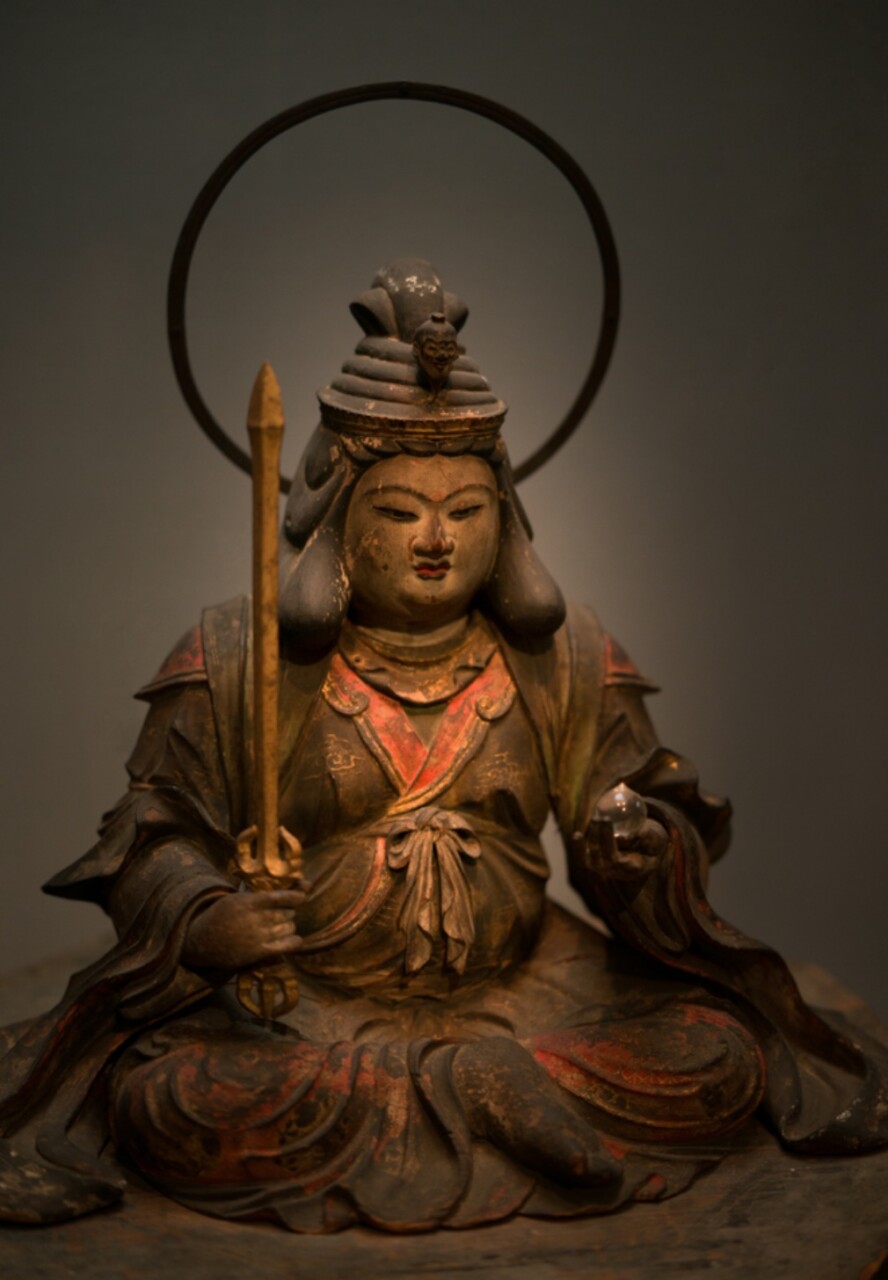
So to recap: Benten-sama or Benzaiten is the goddess of all that flows: water poetry, speech, words, musicians, performers creativity in general, and wealth. Her sacred messenger is the white snake, also connected to bringing wealth and prosperity. On any given day she might have a little ugajin — a human-headed snake coiled and sitting atop her head. The ugajin being revered for rice, water, good fortune, fertility, and wealth. And isn’t all that wonderful.
Okay, I will let you go for now. Thank you so much for listening to and supporting the show. Stay safe and well. And I’ll talk to you get real soon.
Bye bye