Did you know that not all Japanese ghosts are jealous, vengeful women? No. Some are jealous, vengeful men. And in the ghost story I’m going to talk about today, you’ll get — as a bonus — a couple handfuls of bloody, severed, rotting fingers, too. Let me tell you about Kohada Koheiji.
Intro:
Hey hey, this is Thersa Matsuura and you’re listening to Uncanny Japan. The place where I talk about all the more obscure parts of Japanese culture. Be it weird creatures, interesting superstitions, or creepy tales. Or ghosts. Today we’ll talk about one of those.
I hope you are all well. This episode drops literally the same day I’m supposed to turn in the second half of the book I’m working on: Dark Tales from Japan. And folks, I think I’m going to make the deadline. It been a long, harrowing journey, and I’m all sorts of patting myself on the back, exhausted, a little dazed, and “Hey wait, I want to rewrite everything”. I’m also wondering which of the four Next Projects I should tackle first. But before that, I might need to finally get this old house in some semblance of shape, unpack some boxes, and relax a little bit. I’ve kind of become a birder and a bugger (?) along the way. I’ve also got so many books I want to read, too.
So that’s what going on with me. Real quick: Remember patrons get ad free versions of the show, and my next book for middle grade readers is about to start all the pre launch excitement. The book is called Legends of Japanese Mythology: Meet the Heroes, Spirits, Monsters, and Yōkai of Japanese Folklore. It’s not just yōkai, there are ghosts in there and mythological figures, too. The astounding artist, Tomii Masako did the artwork which makes it one of those books that you not only read, but you just sit there for hours and look at the cool art. It’s up on Amazon for pre order (or you can preorder in your local indie bookstore, too). Legends of Japanese Mythology by Thersa Matsuura.
Speaking of ghosts…
Pod:
The tale of Kohada Koheiji is a kind of meta-theatrical ghost story. It’s a kabuki play about an actor, based on a real actor with the same name. And in the play, the actor becomes the ghost he once performed — AND whose ghost was then feared by real actors who performed him because he was angry and haunted any performance of his story.
I’m not sure I got that right. Let’s slow down.
So here’s what we can piece together: There seems to have been a real actor named Kohada Koheiji. And he seems to have been brutally murdered, or just regularly murdered, or died. It’s all a little mysterious. The famous ghost story you hear today and was all the rage back in the Edo Era — the really cool one I’m going to tell you in a minute — was created in the early 1800s by some first rate story tellers and writers.
But it all started in the 1700s, where you have this real actor (Kohada Koheiji) who served as the model for the creepy tale. He was either murdered at Inba Numa (Inba Swamp) or died by taking his own life and interesting aside: his death was hidden from his wife.
I found a little written about the real Kohada Koheiji. It’s in an old essay collection called Kairoku written by a scholar named Yamazaki Yoshishige. In it, Mr. Yamazaki recorded all sorts of things dating from 1820 to 1837. Things like difficult words and phrases that struck his fancy, rumors that were going around at the time, and strange stories he had heard or seen.
One of those unusual stories is about the real Kohada Koheiji. His recollection goes that there was an actor who was so distressed by the failure of his performances, that he took his own life. But because he didn’t want his wife to grieve him, he asked his friend, whatever you do, please, do not tell my wife about my death.
A side note from me: Kohada Koheiji is almost always portrayed as “not exceptionally bright or talented”. I think I understand why that piece of his character endured through the ages and made the ghost story different than your usual scary tale. And this right here might be the impetus for that.
“I’m so sorry, Mrs Kohada. Yes, I’m your husband’s best friend. And, yes, he’s never coming home again. But don’t worry he’s NOT DEAD! You don’t need to grieve.”
I don’t know, I think there is a whole world of even-worse grieving that comes from having no earthly idea what happened to their husband who suddenly disappeared. But Kohada didn’t think so.
So, anyway, the essay goes on to say the wife knew something was up and pleaded with the friend to tell her what happened to her husband. I mean, it’s obvious that he knew something. Here the friend “attempts” to tell her the truth when suddenly strange phenomena occurred.
End of essay.
You really wish Yamazaki Yoshishige had written a few more more details right there. What kind of strange phenomena? I don’t know, make something up?
There’s a separate theory that says the real Koheiji’s wife was, in fact, having an affair with a man named Ichikawa Iesaburō. And Iesaburō pushed Koheiji into the Inba Swamp and drowned him. It’s thought that this version is the one Santō Kyōden — an artist and writer — first wrote about in 1803, the one that kick started the Kodaha Koheiji ghost story mania.
Let’s go on a quick side jaunt into Santō Kyōden. He’s kind of incredible, in so many ways. And I really do want to study him more despite everything I’m going to say from right now. So, he was an artist, writer, and tobacco shop owner. Some say he was Japan’s first modern novelist. And he was really into the Yoshiwara District. The red-light district of old Japan. He actually created some beautiful artwork of famous courtesans along with poems that they themselves had composed.
He also put together some guidebooks for how a man must behave while in the Yoshiwara. This last one got him fined. Then a little later, he managed to get himself handcuffed for fifty days. This, too, it seems was because of what the government called indecent material.
The good news is he met his first wife in Yoshiwara. After she completed her indenture, she was allowed to leave the pleasure district and marry Santō Kyōden whose real name was Iwase Samuru, by the way. But sadly, after waiting so long to get married, she died after only four years. The author Kyokutei Bakin wrote that Kyōden was unable to bear seeing his wife in so much pain. So what did he do? He spent his time in the Yoshiwara…where he eventually met wife Number Two.
I’m already sensing a bit of a theme today of “eyebrow raising logic”. First, “tell my wife I didn’t die so she doesn’t grieve” and second, “I can’t bear your suffering honey, I’m going to go toddle off to Soap Land for awhile.”
Maybe Santō was a saint. It’s actually debated even today whether he was or not. It sounds like he did love his first wife very much, and he didn’t marry his second courtesan until seven years after his first wife passed. He was forty at the time, New Wife was in her early twenties. Okay. But he actually paid so that she could leave Yoshiwara. Okay. But then he also adopted her little sister, whom he affectionately called Tsuru (Crane). Okay. I don’t what’s going on here. And that’s where I stopped reading about Santō Kyōden.
Let’s talk about Koheiji again. Where were we?
Oh, yes, in 1803, Santō Kyōden wrote a novel called: “Fukushū Kidan Asaka no Numa” (The Bizarre Tale of Revenge at Asaka Marsh). It was a hit. So a couple years later, he wrote another: “Asaka Swamp: The Next Day’s Revenge”. It was a hit.
The story was then adapted into a Kabuki play in 1808 by the famous playwright Nanboku IV, with the slightly misleading title: “Iroe iri Otogizōshi” (Colorful Fairy Tales). And from here the story of Kohada Koheiji became legend.
Remember Yotsuya Kaidan’s Oiwa (I talk about her in episodes
42, 157, and 179–yes, I have a girl crush on Oiwa-san). Well not to the same degree, but actors who portray Kohada Koheiji are said to experience strange happenings and injuries. With those performing Yotsuya Kaidan, offerings are made to Oiwa’s shrines. With Kohada Koheiji (since he doesn’t have his own shrine), certain purification rites — called Sekagaki — were performed to protect everyone involved in those productions.
Some notable incidents: Once when the kabuki version first came out, while getting ready to perform some disturbing things happened that were attributed to Kohada’s angry ghost. First, during a script reading something tapped or knocked on the third floor wall. Then the main actor, Matsusuke Onoe, playing both Kohada and his wife, developed a violent fever, followed by his real wife’s face suddenly looking like a man, and then there was the hot water shooting out of an iron kettle.
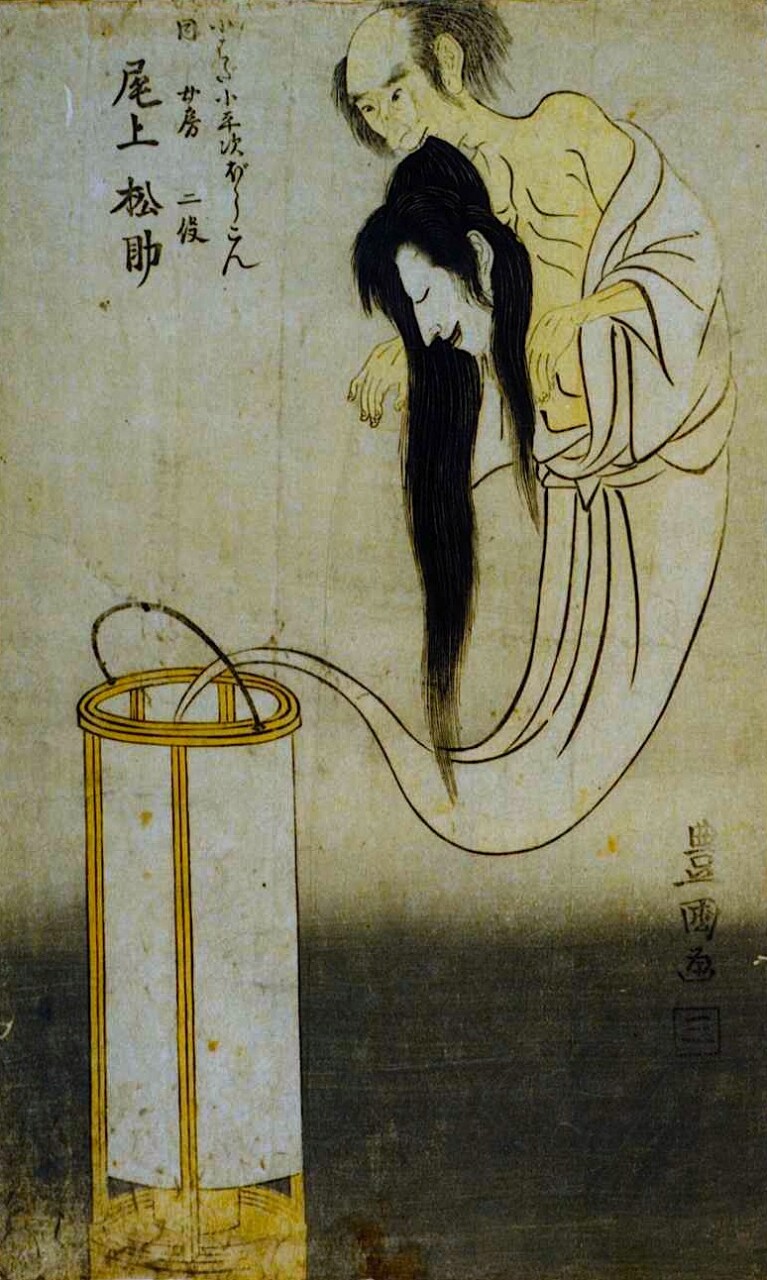
I’m sure if we had more context, those would be much scarier. There have also been reports of injured stagehands through the years. Another superstition that took hold was to never say his name backstage. Lest you invite his angry spirit, and you know, knocking and spewing hot water.
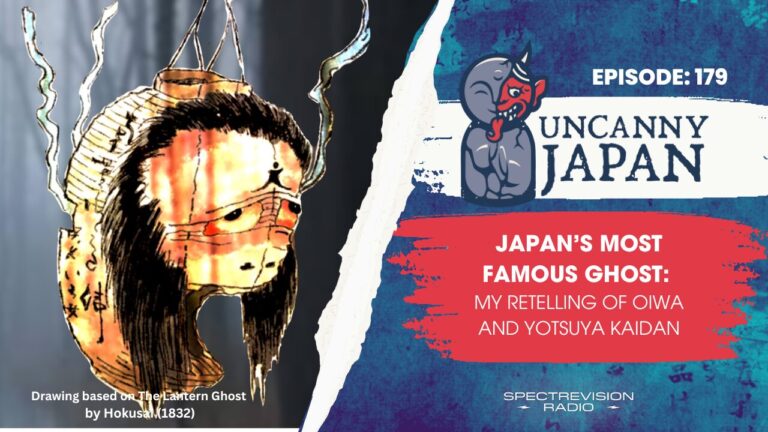
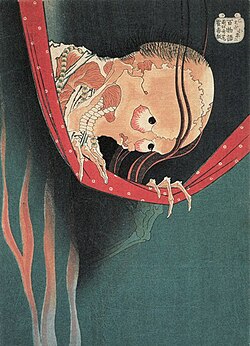
All right, so what’s this ghost story? Know that it’s one of those juicy tales that has been told and retold, there’s the kabuki versions, the novel versions, and the movie and rakugo, and most importantly the artwork. Hokusai made one of the most horrifying images of the decaying corpse of Kohada Koheiji, peeking over a mosquito net. Utagawa Toyokuni made an image of Koheiji’s ghost coming out of a lantern with his wife’s head — that he’s presumably bitten off — in his mouth. Note: that incredibly wonderful and grotesque image doesn’t appear in the story at all. Shame.
Okay. Here’s my retelling of one.
The story:
Mukashi mukashi, there was a traveling actor named Kohada Koheiji. He wasn’t particularly good at acting — in fact, he was terrible at it. Some said he was laughingly bad, some said he couldn’t even earn proper payment, others that he was ignored by troupes and his own teacher pitied him.
The fact that he was a bad actor wasn’t helped by the other fact that he wasn’t good looking. And by good looking I mean, he wasn’t traditionally handsome. He was pale, had a grim face, and just over all “strange”.
But finally, he landed a real role, to play that of a ghost. This isn’t necessarily a great thing. Back then, there was a lot of superstition about playing a ghost on stage, and it was believed something like that invited bad luck. But Kohada Koheiji was nothing if not resilient. He embraced his dour, creepy, off-putting appearance and leaned into the ghost role.
Some stories said he even studied corpses. Practicing the ol’ slack jaw and sunken stare, as well as that “stiffness about the body” that’s found on the newly dead. He got good. He got really good. He got so good that people shuddered when he appeared on stage. He was now known for being the best kabuki actor at playing a ghost.
Meanwhile, while Koheiji is off performing and making a name for himself, his wife, Otsuka, and a stage drummer named Adachi Sakurō decided to become a thing. Yes. They had an affair behind Koheiji’s back. Worse. They fell in love.
Because suddenly Koheiji became inconvenient. But what is a passionately in love couple to do when there is a husband around? Take him fishing, that’s what.
At that time, Koheiji just happened to be performing in the Asaka District. And Sakurō’s older brother, Unpei, lived nearby. Oh, did I mention that Unpei is a bandit chief!?
Sakurō showed up under the guise of supporting Koheiji. Koheiji was thrilled to have his musician friend come all this way to see his performance. Only the weather turned bad and that night’s show was canceled. Well then, Sakurō said, Since you’re not the drinking or gambling type, why don’t we go fishing instead?
That’s sounds really nice, Koheiji said.
Now, keep in mind that Koheiji had just been paid and had five ryō in coins tucked inside his sleeve. So the two go out in a boat on the Asaka Swamp, row out far enough to not be seen by anyone and presumably catch the best swamp fish.
Friendly Koheiji asked what Sakurō has been up to these days and Sakurō says he hasn’t been working, he’s actually been living with a woman. Oh! Really! Who?
Your wife, Sakurō answered.
Before Koheiji can even react, Sakurō shoved him into the water. Koheiji tried to climb back in, but with the help of two of Unpei’s henchmen — who had followed along and had been hiding in the reeds — poor Koheiji was strangled and drowned and sunk to the bottom of the marsh.
Sakurō then hurried to his brother’s hideout. But when he got there, Unpei said: “You’re guest has already arrived.” “What?” Sakurō cautiously went into the next room and there it was, Koheiji’s waterlogged corpse lying on the floor. Strange. But he did have money in that sleeve.
Sakurō went over and retrieved the coins and to add insult to injury, he spit in the dead man’s face. Just then the dripping corpse of Koheiji sat bolt upright, opened its eyes, as one cold hand latched on to Sakurō’s wrist, the one that was holding the money. Sakurō tried to pry the hand off, but it wouldn’t budge. Instead, the dead eyes of Koheiji just stared into Sakurō’s. Sakurō shrieked. Unpei ran into the room and saw the most horrific sight.
His younger brother was pinned under Koheiji who was still holding his wrist it what we can only call a death grip. He, too, tried to pry it off. No luck. He tried to pull the dead body off. Also, no luck. As a last resort, he drew his sword and sliced through Koheiji’s forearm.
But still the hand and fingers clung to his brother’s wrist. He had no choice but to then cut through each of the fingers until they fell off onto the floor. Finally, Sakurō was free.
He’s shook. He’s shook bad. He left Unpei’s hideout and returned to Edo to the love of his life, Otsuka. He told her everything that happened. Yes, he killed her husband. He’s dead. But then the awful stuff with his corpse and the grasping hand.
Otsuka looked confused. What are you talking about? My husband just returned a little while ago and is in the other room right now resting. He’s wet for some reason and paler than usual, but he’s very much alive.
Sakurō’s blood ran cold.
Some believe the reason his wife couldn’t recognize he was actually dead and a ghost was because he was so good playing one on stage that he just kind of looked like that all the time.
Sakuro went into the room. There placed around the body are floor screens. He grabbed ones and tried to slide it open. But it was stuck. But it wasn’t stuck. The reason it didn’t open was because Koheiji was holding it closed with one ghostly hand. Sakurō used all his might and pulled on the screen and when did, it flew open and five fingers clatter to the floor. They quickly start to rot and give off a terrible odor, like they’d been dead for days.
Steel-hearted Otsuka says: “Well, at least he’s dead. That’s what we wanted.”
For awhile after that, nothing strange happened at all. Otsuka and Sakurō lived together as if nothing is out of the ordinary. But then one night Sakurō woke up and noticed there is a man sleeping between them. He thought to himself: “Otsuka has taken another lover!”
Sorry to interject here: But this has to be number three on the wonky logic? Otsuka took another lover, brought him into bed, while Sakurō was there sleeping and the two not only didn’t wake him, but the new lover just fell asleep between them? Okay.
Furious, Sakurō reached for his sword and goes to cut the sleeping man in half when Otsuka woke up and raised a hand in surprise. Maybe she was trying to deflect the blow that she thought was coming for her. Whatever the reason, hand met blade and five of her fingers were severed! The mysterious lover that was lying between them disappeared, but from above they heard Koheiji’s unmistakable laugh.
Otsuka’s fingers, too, shriveled and rotted away.
The two hired a holy person to come and help them. He said the house was full of “death energy” and that the two of them were doomed. But he did give them some talismans and told them to shut all the doors and windows for thirty two days. Whatever they do, do not open a door or window even a crack. The lovers, now rightly terrified of Koheiji’s ghost, obeyed the rules. But every night they heard Koheiji’s spirit circling the house, around and around, furious that he cannot get in. On the thirty second night, Sakuro woke early and thinking that dawn had already come, opened a window too early. It was still dark!
A gust of wind and ghost fire rushed into the house. Otsuka screamed from the other room. Sakurō ran to her but she was nowhere. Instead there was blood all over the walls and long hair hanging from rafters. Her body was never found.
Sakurō survived a little longer. But he had lost everything. He was wondering what to do when he was visited by a monk who came to read sutras. The monk told him that Koheiji’s ghost will take his life within three days. In order to stop this, the monk needed Sakurō’s most prized possession. Sakurō gave him the five ryo coins. The monk took the money and left him with special instructions that had been wrapped in paper. After the monk departed, when Sakurō opened the packet he found fake money. He’d been tricked. Furious, he went out and managed the monk and attacked him. Only the monk became something of a terrifying crazy person and beat Sakurō with his iron staff, so badly he was lie half dead on the ground. Before leaving, the monk stood over him and spit in his face. That night Sakurō burned with fever and began babbling that someone was pulling him under water and choking him. He thrashed wildly and eventually died after having lost his mind.
The end
Let me end with a wonderfully silly pun that was attached to poor Kohada Koheiji and was all the rage back in the Edo Era. So his last name, Kohada, written with different characters is also the name of a small silver fish that was much loved in Edo-style sushi.
So someone sitting down with friends to enjoy some sushi might look at the kohada sushi on the plate and say: Yūrei ga kowakute kohada kueruke-?「幽霊が怖くてコハダが食えるけぇ!!」 — “Me? Afraid of ghosts? If I were scared of ghosts, how could I eat kohada?”
Thank you for listening, stay safe and well and I’ll talk to you in two weeks. Bye bye.