Since the last episode was all about animal spirits (like foxes, snakes, and horses) that can get a little possess-y and cause disease and ill fortune, I thought why not do a show on keeping yourself safe from harm, the Japanese way. I think we can all use a little protection and auspiciousness these days. So let me tell you about omamori and ofuda, charms or talismans, that will not only protect you from evil spirits and general harm, but might also help you find your perfect partner, ace your exams, and fill your bank account.
Hey hey, this is Thersa Matsuura and you’re listening to Uncanny Japan. The place where I talk about all the more obscure parts of Japanese culture. Be it weird creatures, interesting superstitions, or creepy tales. There’s lore, there’s legends, there’s uncanny.
It’s warming up here in Shizuoka. The cherry blossoms have run their course, and I believe “digging up bamboo shoots” season is upon us. I went out last week to some old castle grounds to pick warabi, a mountain herb, and while there fell in love with the birdsong. Especially the uguisu (bush warbler). So I packed up the mics and headed back out after the rain stopped. So spring birds is today’s background. Very fortuitous, I think.
You can also hear me traipsing around in the forest and one bird that sounded like a child screaming. You might hear me gasp and trucking on over to find out who was screaming. I was about halfway there, realized it wasn’t a child, followed by realizing this is textbook *insert name of evil spirit or trickster creature* leading a dumb person to their demise, so I turned back.
I’ll pop this soundscape, too, up for patrons, as well. Remember, you can also — for most tiers — get ad-free versions of the show, extra content, and monthly bedtimes stories read by me, if you’d like to join the uncanny family over on Patreon.
Okay, now let’s get to our lucky charms. I’ll talk about two varieties while going off on some weird and interesting tangents and end with a freaky story my ex husband just told me that I’m still trying to unpack.
All right, maybe you’ve seen them, there’s the ofuda (お札) and the omamori(お守り)
First, a quick and simple explanation of what they are. Both an omamori and an ofuda are objects believed to be imbued with the power of the gods (Shinto) or Buddhas (Buddhism), and by having one or carrying one with you, you keep evil and misfortune away. They are thought to not only bring protection but they can also help grant prayers and certain wishes that you’re asking for.
Let’s start with the ofuda. An ofuda is the older of the two. It’s typically a strip of paper or wood. Or wood wrapped in paper. The paper kind are called kamifuda (paper fuda), the wooden ones, kifuda (wooden fuda). They’re usually rectangular although there can be other shapes as well. I used to get one that was a teardrop shape.
Let’s look at the origins and some of the things that converged to give us our modern day ofuda. Remember that way back, words and symbols were believed to hold power. Even more so than today. So writing a certain word or phrase down or drawing a symbol and hanging it in a doorway was done for protection.
Then you have your Daoists who came along and also used talismans and did magic and alchemy-work. After that: onmyōdō, much of the same. In Buddhism, too, there were woodblock prints of sutras or images of Buddhas that were believed to bring protection. These, too, were either carried, posted somewhere, or kept in homes.
Here’s something fascinating. The Kumano Shrines developed something called GoOhōin (Ox King Seals). The oldest record of one of these is in the late 600s. These were highly powerful talismans that warded off evil and misfortune among other things.
They were woodblock printed on paper and stamped with a red vermillion seal. Which is looking a lot more like our modern day ofuda, BUT these were super cool because they were written in what was called karasu moji, crow writing. This is a writing style that looks to be made of a bunch of little crow images. These charms weren’t only protection against fire, theft, and healing from illness. They had another purpose. And here’s the cool part.
On the back you would write an oath. The first recorded evidence of the oath versions appeared in the mid 1200s, so a little later. The practice of writing your oath behind the name of god was extremely powerful. It was like you were swearing directly to the gods themselves. You did not want to break this promise.
Here’s the chilling part. It was said that if you did break the oath, three of Kumano’s sacred crows would die. Also, the oath breaker, you in this case, would cough up blood and die. And, also, go straight to hell.
Another version of this oath-taking was that you burned the paper, mixed it with water and drank it. In this one, if you broke the promise made to the gods, not just three, but the number of sacred crows that had been drawn on the paper would die. That could be as many as 88. And of course, coughing up blood and hell for you.
It gets even more fascinating. There was even a saying: “uso wo tsukazu ni shinjitsu wo kataru to, gō ō hō in ni chikae”. 嘘をつかずに真実を語ると、牛王宝印に誓え
Basically, “if you speak the truth without lies, swear it on the “Go O Ho in”.” And ancient “Cross your heart and hope to die, stick a needle in your eye” sort of statement.
It is said that those with something to hide would sometimes confess simply upon being challenged by this phrase. It was that terrifying.
Okay, we’re going through the steps to our modern day ofuda. Other things that contributed to what we have now are your pilgrims and itinerant monks. They carried talismans and spread them around as they traveled across Japan. Receiving one of these was like being connected to the actual temple no matter how far away, or proof that your prayers had been carried there.
Then by the 1700s there came an Ise Shrine Ofuda. — Remember the Ise Grand Jingu enshrines Amaterasu, the Sun Goddess, THE most important deity in Shinto and the mythical ancestor of the imperial family.
So it’s incredible to imagine that in an age when the fastest mode of transit was a horse, these ofuda were able to be so widely distributed. It is believed over 90% of households in Japan had one. So it’s around this time that the real practice of keeping an ofuda in your home became somewhat of the norm.
Keep in mind, there are as many different kinds of ofuda as there are shrines and temples, but in general, they’re usually long and rectangular, about the size of a bookmark or a long narrow envelope.
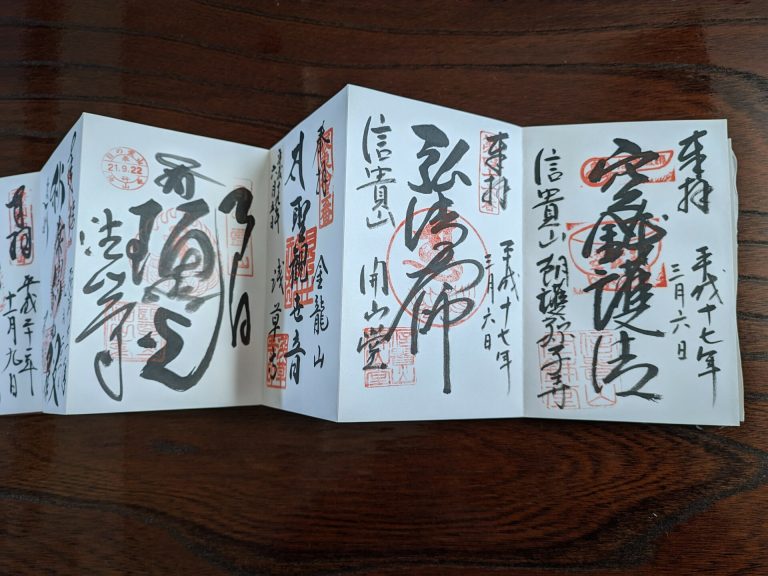
Often paper wrapped around a thin wooden core. On the front you usually see the name of the temple or shrine—like Ise Grand Shrine (this tells you where the power is coming from), and/or the name of the deity— Amaterasu Omikami. Then possibly what the ofuda is for, yakuyoke (warding off misfortune) or hibuse (fire protection). There should be a red seal, called a goin on it. This is authorization letting you know it’s not just some printed paper passed along. It had weight and power.
Ofuda can be found at both temples and shrines. Think of it as: the Shrine ofuda invite the kami or god or deity into your home and blessings are incurred that way. The Buddhist ones bring the protection of Buddhas or Bodhisattvas. Shrine ofuda are a little more minimal and emphasize the kami and the shrine name. Temple ofuda might have sanskrit on them, Buddhist imagery, flames. They’re much more esoteric-looking.
Despite some old folk tales you might hear, these days, you don’t carry ofuda around with you. They’re placed inside your home or at the entrance. Think of them as being anchored to the household.
Places you can put your ofuda: if you do have a kamidana (god shelf), that’s a good place to put one, or two. But some are hung near the front door, in the kitchen, on the family altar (butsudan), and even in your toilet.
They’re placed higher than eye level and face east or south. The area around them is kept clean and with respect. Side note: I’ll talk more about kamidana in a future episode — as someone who now lives in a house where there is a kamidana in the corner of nearly every room, I’ve counted five so far — I’m studying up on them.
Because certain ofuda are tied to certain gods you can have one or many for different reasons. So the one at your front door might be Tsuno Daishi (whom I talked about in Ep. 43: The Great Horned Master). He’s there to ward off demons and stop illness from entering your home. The one in your kitchen might be a kamado or hearth deity. Let’s say Kōjin, kitchen or fire gods. Not just “fire is life and sustains us, thank you”, but also protection against house fires.
Then you have Ususama Myōō, a very fierce deity who purifies impurity. He guards your toilet. Need I say more? Oh, I did actually say more. There’s a whole episode on the Toilet God (Ep. 98: Toilet Gods) As for Ususama Myōō. I once climbed a mountain in the outskirts of Kyoto and found a temple that had an ofuda for him, so I got one and, yes, I brought him to my new old house. So I’m not completely alone here, I guess.
The idea is that the ofuda doesn’t just represent the kami or deity, but it actually contains it or channels its essence. You can see why they are so well taken care of and revered.
Here’s a fun and relatively new tradition: So, back in the day when people lived in one-story houses this wasn’t a problem, but these days you have apartment buildings and condos, so a new practice has emerged. How can your ofuda connect with the gods if there are noisy obnoxious people living in the apartment above you? They can’t, that’s how.
If you find yourself in this situation, you should write the kanji for cloud, (or sky or heaven) on the ceiling above where the ofuda is hanging. Writing directly on the ceiling isn’t the best idea surely, so you can brush and ink it on a piece of paper or if you’re in Japan, some shinto shrine supply stores have them pre brushed.
All you need to do is tape it up there. You can print one out as well. Although, I have it on good authority, the gods prefer your careful attention and focus when you write the word traditionally with brush and ink. They don’t care about your hand writing. So no worries there. A clever modern way to bypass those pesky neighbors with the rumba.
Here’s a myth that I believed for decades because my mother-in-law told me. She said that you should never have more than one ofuda or omamori because if you do the gods will fight amongst themselves and it diminishes their power. I told her I thought gods would be above fighting with each other and she got angry at me.
Turns out, I was right. It’s actually okay to have more than one ofuda on your kamidana, and it’s also okay to have one of the Buddhist persuasion alongside one of the Shinto flavor.
I mean, Buddhism and Shinto were practiced hand in hand for over a thousand years. That is until 1868, when the Shinbutsu Bunri was declared by the Meiji government and they were forcefully separated.
Oh, and about my mother-in-law telling me that. I’m finding all sorts of ofuda and omamori in this house, so she obviously didn’t believe what she said.
So it’s okay to have more than one, but remember, too, having too many kind of dilutes your attention. You might not be able to properly thank and care for each deity if you have, like, thirty. So it’s not the more the merrier. More strategic alliance.
So think of ofuda as a kind of boundary magic, a spiritual firewall installed to protect your house and family.
Then what are omamori? Omamori are smaller amulets or charms that look like a little cloth or vinyl pouch. They’re usually colorful, with an intricately knotted string attached for hanging or tying to things, like your purse, wallet, cell phone, or rearview window.
They might have little bells. attached to them, too. The clear sound of a bell scares away evil spirits, by the way. Why do you think all bell ringing in temples?
Omamori differ from ofuda in that they’re portable, personal, and relate to specific wishes. They protect the individual. They’re also relatively newer than ofuda. At least what we think of as omamori these days are. The types we recognize today came about in somewhere around the 1600s.
Now, of course people have always carried things with them for protection. Back in prehistoric Japan, they had magatama stones (another future episode on those coming up). So the idea of carrying something on your person to protect yourself has been around since we crawled out of the slime and that first legged fish picked up an acorn in its mouth and carried it around. Okay, not that, but you know what I mean.
They’re also considered sacred and not toys or decorations, although they are a little more playful and creative in the sheer variety of their designs.
Inside the omamori pouch is a mini ofuda itself, a piece of paper with a magical inscription on it. But do not open them to look at it. You’re never ever supposed to open them. Imagine by opening one, you just released all the spiritual power and goodness. Poof. Gone. What a waste of money.
Don’t worry, the pouch, too, will have its purpose written on it, so there’s really no need to open one anyway. It’s just curiosity really. I get it. I can honestly say I have never opened one.
But once while visiting a local temple that I like to go to because there are statues of tengu and tengu masks and giant tengu geta shoes there — great vibe — I was minding my own business, no one was around, because I like to go at off times.
And I watched a monk shuffle outside holding an open omamori bag. He went over to the big cauldron where people burn incense. These things are feet deep in ash, so you can imagine it. He goes and dips a little spoon in and puts some fragrant ash in the bag. I watched him seal it as he disappeared back into the temple. Don’t know what that means. Don’t know if anyone else does it. It might only be his thing. No idea. But I thought it was neat that I saw it.
Okay, you have your ofuda that protect against house fires and illness and things. What do Omamori do? Basically they are either: Protect me from this. Or Please make this happen.
There are your yakuyoke (warding off misfortune and evil) as well as Kaiun (inviting good luck). There’s also physical safety. Kenko, for general good health. Byoki Heiyu, recovery from illness. Anzan (safe childbirth), because childbirth is scary and dangerous. Also money and work related omamori. Shobai hanjo, business success. Kinun, financial luck.
Students love to carry omamori, too. There’s gakugyo jōju, academic success. And also the ever present passing your exams omamori. Don’t forget: Kotsu anzen, which is for safety while driving or any transportation, really. There are some for home and family protection as well as for winning in sports. And finally, we can’t forget love. One of the biggies is enmusubi, finding love or making cherished relationships.
It’s not unheard of to buy an omamori for a person either. A little gift of luck. I’ve done that a lot through the years. Especially if I’m at a very interesting, out of the way temple and I think a certain someone might like or need one.
Omamori, too, can be purchased at shrines or temples. Some bigger shrines and temples will sell them online. I even found quite a few Japanese websites that had patterns on how to make your own omamori, which goes against everything I just said for the past thirty minutes and sounds pretty sacrilegious, but the sites were made by Japanese people and the omamori were super cute. So what do I know?
A last important note when keeping and handling your ofuda or omamori. While some people carry around an omamori for years or keep their ofuda hung on their wall for years, you’re actually supposed to properly dispose of them once a year. This is usually New Years but if you bought yours at a different time, then whenever the year is up. The idea is that the power of protecting and granting wishes and prayers lessons over time. You need a new fully charged charm or talisman.
Whatever you do, don’t throw one into the garbage. You’re supposed to take it back to where you bought it, but if that isn’t possible you can sometimes send them back (I’ve done that, but it costs money just to have them throw it on a fire and then more money to get a new one). Local shrines and temples usually will take ofuda and omamori from other places and burn them in a ceremony they do at specific times.
Okay, let me end with a freaky synchronicity that just happened.
Literally, yesterday as I was working on the episode. No one knows I’m writing a show on ofuda or omamori. Particularly not my ex husband who came over the other day for some reason. And I didn’t mention it to him. I don’t think he knows I have a podcast to tell you the truth. But I was telling him about a walking route I just found along a river that has some cherry trees.
That spurred a memory in him that had him all freaked out. So he said along that same river (much closer to where he’s living, not where I’m living now) he remembers vividly being told to go after midnight to this narrow bridge over the river, alone, then to take an ofuda that was given to him and #1 make sure no one is watching. This is after midnight and there aren’t any streetlights near the river so… Then he was told to throw the ofuda over his shoulder behind him into the river, and whatever he did DO NOT LOOK BACK. To go directly to where he parked and return home immediately.
I had a lot of questions. Was that a dream? No, absolutely not. Was it before we were married? No, I was in the picture and our son was in kindergarten. He remembers that. This whole scenario is impossible — I tell him — because every single night, not missing one, since we got married he’d have a drink or two or more at dinner. So he would never and did never go out in his car at midnight, unless I was driving. I am 100% sure of that. He agreed.
So he was wracking his brain to figure out what this memory was about. Then I had an idea. I suggested maybe it happened when I was in America, that time I got sick, like I just mentioned here last episode. And he said that might have been it. Yeah, that would make sense. And I also said, it does make total sense that your mother would want to cleanse you of anything bad, especially illness, given I was sick. Nothing contagious by the way, but you couldn’t tell my mother-in-law that.
The whole story felt icky. Because it really gives off ushi no koku mairi (Ep. 52: Putting a Curse on your Enemies). Which is disturbing to me, the whole not looking back whatever you do feels a little dark.
So I wonder what was being exorcised from his life. And the fact that he can’t remember parts of it no matter how hard he tries. So we still don’t know the details and never will. He just remembers having to do it and being a little scared and creeped out. The whole story gave me chill bumps.
Allrighty then. Thank you for listening. Oh, both the last episode and this one, I’ve done all on my own. Since joining SpectreVision Radio and having my life a little shaken up, I’m trying to figure things out and one thing I want to do is reenergize the show. So I’m going for longer and more in depth episodes than I’ve done in the past.
So please let me know what you think and also about the audio and editing. I’m doing all that, too, and I’m nowhere as good as Richard, so if you hear anything weird or off, reach out and let me know. I’m still learning. And no one has ever said I was a fast learner.
Hey, I wonder if there’s an omamori for good podcasting chops. Hmm…